
Bedside Handrail Complete Buyer Guide
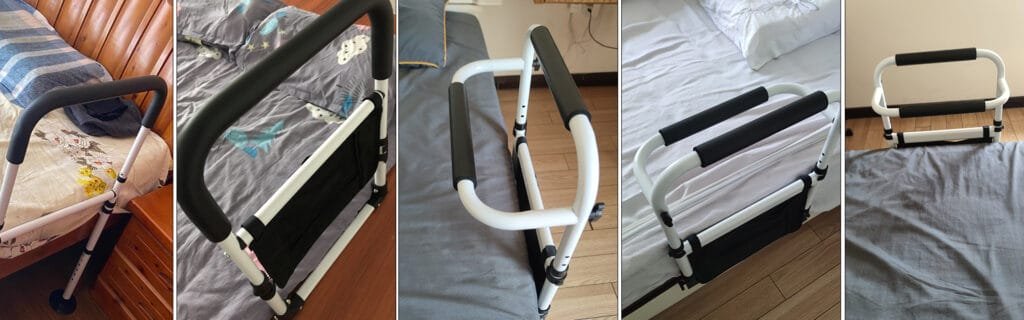
Comprehensive Insights into Bedside Handrails
When a distributor or a facility buyer asks which bedside handrail is the safest, the honest first answer is a question back: safest for doing what? A rail that helps someone push up from lying to sitting and a rail that runs along the side of a bed to keep a person from rolling out share a name in most catalogs, but they are different products with different risks, and regulators treat them differently. Most rail comparisons skip that distinction and go straight to height ranges and finishes. That is usually where the trouble starts.
This guide follows the order we would normally take a buyer through it in person: what job the rail has to do, what risk comes with each type, what to check in construction and paperwork, and only after that, which supplier fits.
Two Jobs Hiding Behind One Product Name
Assist handles and transfer rails are for the person using them. The resident grips the rail to sit up, swing their legs over the edge, stand, or shift position in bed. Side rails along the mattress edge are for the bed itself, placed to stop a body moving off the side. Catalog labels blur the two, so adjustable bed rails, foldable bedside grab rails, heavy duty bed rails, portable bed rails, no drill bed handrail models, half length bed rail designs and anything called a safety bed handrail often sit side by side on the same page.
For a buyer, the practical point is that the risk changes with the job. A grab rail used by a resident who is awake and alert is a mobility aid. A rail left in place overnight next to someone who moves in their sleep, or who is confused, is a different situation altogether, and it is the one where serious incidents concentrate.
| Rail Type | Main Job | Fits Best | Check First | Ask the Supplier |
|---|---|---|---|---|
| Adjustable bed rail | Transfer and repositioning support at different heights | Residents whose height or mobility varies | Whether the height lock holds under a real pull, not just a static load | How is the locking mechanism tested, and over how many cycles |
| Foldable bedside grab rail | Folds out of the way for caregiver access | Home care, tight rooms | Play in the hinge after months of folding | What happens to hinge tolerance after repeated use |
| Half length bed rail | Support at the sitting-up point without full-side coverage | More active residents | The gaps at each end of the rail and how they sit against the mattress | Which gap zones were assessed, and how |
| Heavy duty bed rail | Higher-load support for daily heavy use | Bariatric users, busy facilities | How the unit is anchored, since more weight makes a loose mount worse | In which direction and on what assembly the load rating was tested |
| No-drill or portable bed rail | Installs without altering the bed | Rentals, temporary or home beds | Whether it stays firmly against the mattress and frame | How is it secured, and which mattress thicknesses were checked |
None of these is simply “the good one.” Each is right for one job and risky when pushed into another.
Why Entrapment Is the Question Behind the Question
Anyone who has sourced bed rails for a while knows the word, and buyers new to the category should learn it early. Entrapment means a person becomes wedged in a gap: between the rail and the mattress, between the bars of the rail, between the rail and the headboard, or between the floor and the rail. It is the dominant hazard pattern in the safety data, not a rare edge case.
In the United States, both the FDA and the Consumer Product Safety Commission have received many death and injury reports involving adult portable bed rails and hospital bed rails, mostly entrapment and falls. In one CPSC review covering January 2003 through September 2012, staff looked at 160 incidents involving adult portable bed rails, 155 of them fatal, and found that 145 involved rail entrapment. For hospital beds, the FDA recorded 901 incidents of patients caught, trapped, entangled or strangled between 1985 and 2013, including 531 deaths, and noted that most of those patients were frail, elderly or confused.
Those are US figures, and they describe reports received rather than a complete count. But the pattern was consistent enough that the CPSC adopted a mandatory safety standard for adult portable bed rails in 2023, built on an ASTM standard and tested with the entrapment probe described in the FDA’s 2006 hospital bed guidance. Which agency covers a given rail depends on how it is marketed: rails sold for medical purposes fall under the FDA, and others under the CPSC.
The FDA also says plainly that adult bed rails should not be used as restraints, that they are not right for every person or situation, and that even a well-designed rail that fits the bed can be a hazard for people with physical limitations or altered mental status, such as dementia or delirium. If you sell into another market, the specific standard will differ, and it is worth confirming current requirements with your local regulator. The hazard itself does not change at the border.
Who the Rail Is Actually For
This is the part of the conversation suppliers often skip because it slows the sale. A facility that says it wants rails on every bed to cut falls is describing a policy, not a clinical decision. The FDA points facilities toward assessing each individual resident before a rail goes on the bed, whether in a hospital, a long-term care home or a home setting, and that assessment belongs to the care team, not to the equipment vendor.
What a distributor can do is make that assessment easier. Offer options that suit different resident profiles, explain plainly which rail types are transfer aids and which act as barriers, and avoid describing any rail as a fall solution for everyone. A buyer who hears that from a supplier usually trusts the rest of the conversation more, not less.
Construction Details That Matter More Than the Headline Spec
Once the job is clear, the build questions get much sharper. Most rails are aluminum or steel. Aluminum is lighter for caregivers to reposition, and steel tolerates rough daily use in busy facilities. Neither is automatically better. What counts is tube wall thickness, how the joints are welded, and whether the manufacturer runs fatigue testing on the load-bearing points instead of relying on a one-off static test done on a new sample.
A short list of things worth checking on any sample, from any supplier:
- Weld quality at the base bracket and at every hinge or telescoping joint
- How the height lock behaves after hundreds of adjustments, not just when it is new
- Grip surface wear, resistance to cleaning chemicals, and whether it stays non-slip when damp
- How firmly the rail sits against the mattress edge, since a rail that can drift away from the mattress creates exactly the gap the safety data is about
- Mattress compatibility, because thicker or softer mattresses change the gap dimensions
- Edge finishing and contact surfaces, so the rail does not dig into the mattress or mark the bed frame
On load ratings, ask what the number actually means. A figure in kilograms tells you very little without knowing the direction of the test load, how many cycles it covered, and whether it was run on the finished, assembled rail. A pull test at the height a resident really grips says more than a vertical static test at the top of the tube.
These are easier to judge from the production floor than from a datasheet. We document our tube processing, welding and testing equipment on our equipment page, which is usually the quickest way for a buyer to see how a Zhongshan Dinglian factory handles the steps that decide whether a rail is still tight a year later.
Installation and Inspection: Where Good Rails Quietly Fail
Even a well-built rail loses its safety margin when it is installed badly or never inspected. Loose bolts, worn grips and a mounting strap that has stretched are ordinary wear items, and they change how the rail behaves without any visible damage. Facilities that build a two-minute rail check into the bed-making routine tend to catch these early. No-drill and portable designs deserve extra attention here, since they depend entirely on clamping or strap tension rather than fixed bolts.
A written installation guide should come with every rail, and the supplier should be able to say what a correct installation looks like for the bed type in use, whether standard, hospital or bariatric. If a supplier cannot describe that clearly, treat it as information about the rest of the product.
What This Means for Distributors
If you resell rails, your position sits between the manufacturer and a care team that will make the clinical call. That makes a few habits worth adopting early:
- Describe each model by the job it does, and never as a general fall-prevention answer
- Pass the manufacturer’s instructions and warnings on to the customer in full, not a shortened version
- Keep the documentation for each model on file, including test records for the market you sell into
- Treat customer reports of loosening, gaps or near-misses as something to act on quickly
This is procurement guidance, not legal or clinical advice. Requirements differ by country, and the care team and your local regulator have the final word on what is appropriate for a given resident and market.
How We Approach This at Zhongshan Dinglian
As a rehabilitation equipment manufacturer, Zhongshan Dinglian builds its bedside handrail range mainly as transfer and repositioning support, with adjustable height levels and contact surfaces designed not to dig into the mattress or mark the bed frame. That is a deliberate choice about the job the product does, and we would rather explain it plainly than describe every rail as the answer to every risk. You can browse the range on our bedside handrail page, where models are grouped by how they are used rather than by price.
Because tube processing, welding and finishing sit in the same factory, a question about a particular rail can be traced back to how it was made. If you are comparing suppliers, our company background page gives more context on the manufacturing history behind that.
Practical Next Steps for Procurement Teams
- Decide first whether the need is transfer support or bed-edge coverage, and write that into the inquiry
- Ask each supplier for entrapment assessment documentation on the specific model, for the market you sell into
- Request samples and test them on the actual beds and mattresses in the facility, not a showroom bed
- Involve the care team in choosing rail type for each resident group
- Build a short, regular rail inspection into staff routines from the first day
Final Thoughts
A bedside handrail looks like a simple piece of tube and a bracket, which is why the category gets bought on height range and price more often than it should. The better questions are what job the rail is meant to do, who it is suitable for, and what the supplier can show about how it was built and tested. Buyers who ask those questions early usually end up with fewer returns and, more importantly, fewer incidents to explain.
If you want to go through a specific bed type or facility setup, we are glad to look at it model by model. You are welcome to contact us to talk through what your situation calls for.