
Commode Chairs for Hospitals and Nursing Homes: What Buyers Should Know
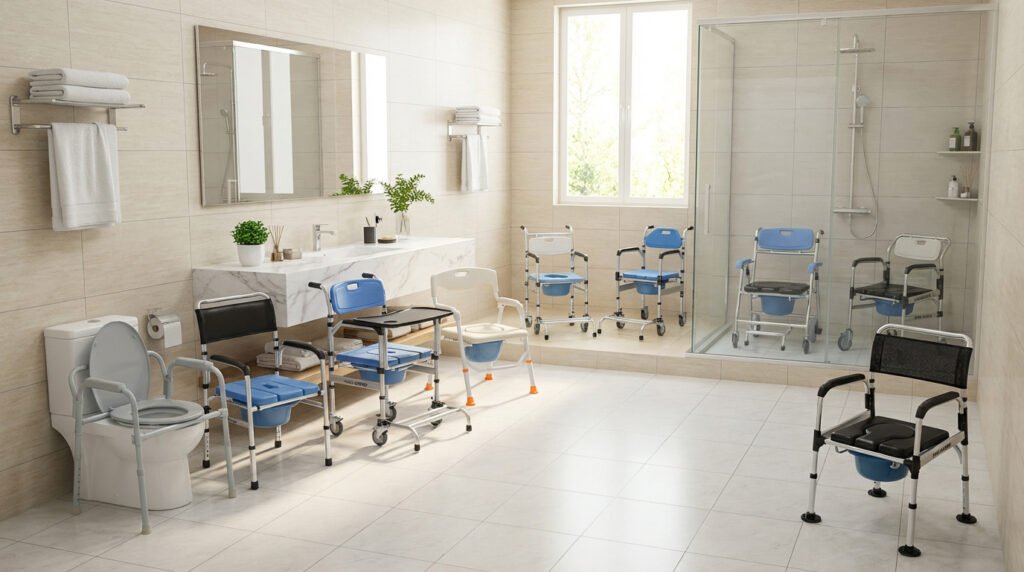
Commode Chairs for Hospitals and Nursing Homes: What Buyers Should Know
“Hospital or nursing home” sounds like it answers the sourcing question, but it mostly just names two buildings. The detail that actually determines which commode chair makes sense isn’t the type of facility — it’s how many different people will sit in that chair, and for how long. A hospital ward and a nursing home floor can order what looks like the same product and need genuinely different things from it, because the use pattern underneath is almost opposite.
Once that distinction is clear, the rest of the sourcing conversation gets a lot easier to have — with a supplier, and with whoever is actually making the purchasing decision on the buyer’s side.
Why “Hospital or Nursing Home” Is the Wrong First Question
A commode chair in a hospital ward typically serves a rotating population — one patient for a few days, then a different patient entirely, often with no guarantee the bucket, seat, and frame were deep-cleaned to the same standard between each handoff. A commode chair in a nursing home more often belongs to one resident for months or years, used daily by the same person, with the same body, the same routine, the same wear pattern repeating thousands of times.
Those are not variations on the same problem. One is fundamentally about infection control between strangers. The other is fundamentally about durability and dignity for one person over a long stretch of time. A chair optimized for the first scenario — fast-clean surfaces, quick-release buckets, rapid caster locking for busy ward turnover — isn’t automatically the right choice for the second, where comfort, a less clinical appearance, and long-term structural fatigue resistance matter more than how fast it can be wiped down between patients.
The Hospital Pattern: Many Patients, Short Duration, High Turnover
In a hospital setting, the central design problem is really about handoff speed and infection control, not about any single patient’s comfort over time. A ward nurse moving between rooms needs a chair that can be repositioned quickly, cleaned thoroughly in the time available between patients, and trusted not to carry anything from one user to the next. Height compatibility with hospital beds and stretchers matters here specifically because transfers happen often, sometimes multiple times a day for a single patient, and a mismatch in height turns every transfer into a small negotiation.
This is also where removable, sealable buckets earn their keep — not as a general hygiene feature, but because a ward may be cycling through several different patients on the same chair within a single shift, and the margin for error on cross-contamination is genuinely tight.
The Nursing Home Pattern: One Resident, Long Duration, Daily Routine
A nursing home resident using the same commode chair for a year puts a completely different kind of stress on the product. Infection control between strangers isn’t really the issue — the chair isn’t handed off to new users every few days. What matters instead is whether the padding holds up after thousands of sit-down and stand-up cycles, whether a drop-arm mechanism still releases smoothly after a year of daily adjustment, and whether the chair looks and feels like something a person would want in their room rather than something borrowed from a hospital supply closet.
Caregiver routine matters differently here too. A nursing home aide isn’t cleaning the chair between different patients multiple times a shift — they’re maintaining one chair, for one resident, as part of a daily care routine that’s repeated for months. That shifts the priority from rapid-cycle hygiene toward long-term structural reliability and a design that doesn’t make the resident feel institutionalized every time they use it.
| Dimension | Hospital Pattern | Nursing Home Pattern | What This Changes in the Chair | Sourcing Note |
|---|---|---|---|---|
| Who uses it | Rotating, multiple patients | Usually one resident, long-term | Hygiene design vs comfort design priority | Ask how many different users the chair is meant to serve |
| Primary risk | Cross-contamination between patients | Fatigue failure from repeated single-user cycles | Bucket sealing vs frame fatigue testing | Match the test data to the actual risk, not a generic spec |
| Turnover speed | Fast, sometimes multiple times per shift | Slow, the same chair stays in place for months | Quick-release components vs sturdier fixed assemblies | Faster isn’t always better if it’s the wrong priority |
| Compatibility needs | Must match bed and stretcher heights for frequent transfer | Must fit the resident’s own room and routine | Height-adjustable frames vs personalized fit | Confirm which compatibility actually applies to your buyer |
| What “quality” means | Reliable sanitation cycle after cycle | Structural and comfort reliability over months of daily use | Different testing priorities for the same word “durable” | Ask a supplier which testing standard the model was built for |
Where Facilities Actually Blend Both Patterns
The hospital-versus-nursing-home split is useful as a starting framework, but real facilities don’t always sit neatly on one side of it. A step-down rehabilitation unit inside a hospital might keep the same patient for several weeks, closer to the nursing home pattern. A nursing home running a short-term rehab wing alongside its long-term residential floors is effectively running both patterns under one roof, and buying a single chair type for the whole building usually means compromising somewhere.
This is worth raising directly with a facility buyer rather than assuming the building type settles the question. A procurement manager who can say “most of our floor is long-term residents, but we have a twelve-bed rehab wing that turns over weekly” has just told a supplier two different things to design around, not one.
What to Actually Ask a Supplier Based on Which Pattern Applies
Once the use pattern is clear, the questions worth asking shift accordingly, and they’re more specific than a general features checklist:
- For high-turnover settings: how quickly can the bucket be removed, sealed, and replaced between patients, and what’s the sanitation protocol it was designed around
- For high-turnover settings: does the frame height match standard bed and stretcher heights used in the facility, to avoid awkward transfers
- For long-term single-resident use: what fatigue testing was done on the drop-arm or adjustment mechanism, specifically across repeated cycles rather than a single demonstration
- For long-term single-resident use: does the padding and upholstery hold up to months of daily compression without flattening or cracking
- For mixed facilities: can the same supplier provide both configurations under one order, with consistent parts and support across both
A supplier who can answer these without redirecting back to a generic weight-capacity number is usually one who actually understands the difference between the two use patterns, rather than selling the same chair into both markets under different labels.
How This Plays Out in Daily Transfers
Transfers are where both patterns eventually intersect, since every commode chair — hospital or nursing home — exists to support a moment of moving someone on and off it. In a hospital, that moment happens with staff who may be meeting the patient for the first time that shift, working quickly under time pressure. In a nursing home, the same moment happens with a caregiver who knows the resident’s specific mobility pattern, repeated the same way day after day.
This is also where complementary equipment tends to matter. A facility managing frequent bedside transfers often pairs a commode chair with supporting handrail hardware positioned at the bed, since the actual risk during a transfer concentrates at that handoff point rather than inside the commode chair itself. It’s worth considering the two together when specifying equipment for a unit, rather than treating them as separate purchasing decisions made months apart.
Manufacturing Background Behind Both Configurations
Supporting two genuinely different use patterns under one product category requires a manufacturer that actually designs for both, rather than adapting a single base model with cosmetic differences. As a commode chair manufacturer, Zhongshan Dinglian produces configurations built around each of these patterns specifically — reinforced, quick-clean frames suited to high-turnover hospital use, and padded, long-term designs suited to single-resident nursing home use. You can see the current range organized this way on our commode chair page.
As a factory handling tube processing, welding, and finishing under one roof, the two configurations share the same quality discipline even though they’re built for different use patterns. You can see the production and testing setup behind that on our equipment page, and our company background page covers more of the manufacturing history behind both product lines.
Practical Next Steps for Procurement Teams
- Identify which use pattern actually applies — rotating multi-patient use, long-term single-resident use, or a mix of both within the same facility
- Match the testing data you request to the real risk: sanitation cycle testing for high-turnover settings, fatigue testing for long-term use
- Confirm frame height compatibility with the specific beds and stretchers in use, if transfers are frequent
- Ask whether padding and upholstery have been evaluated for extended single-user wear, not just initial comfort
- Consider pairing with bedside support hardware if transfer frequency is high, rather than specifying each piece of equipment in isolation
Final Thoughts
The useful question isn’t whether a commode chair is “for hospitals” or “for nursing homes” — it’s whether it was actually built around rapid multi-patient turnover or around one resident’s daily routine over months of use. Facilities that specify equipment based on that distinction, rather than the building label, tend to end up with chairs that actually hold up to how they’re really used.
If you’re working through a specific facility mix — a ward, a long-term floor, or a blend of both — our team can walk through which configuration fits your actual use pattern. You’re welcome to contact us to discuss the details.