
Rolling & Wheeled Shower Chairs for Easy Mobility
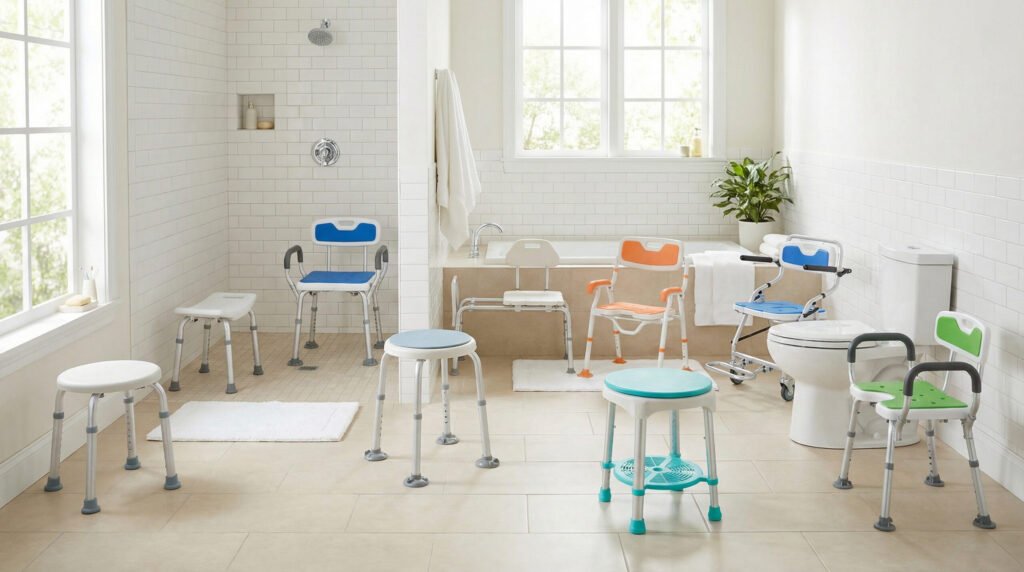
Rolling & Wheeled Shower Chairs for Easy Mobility
Adding wheels to a shower chair solves one problem cleanly — the patient no longer has to be lifted or walked into the bathroom. But it introduces a whole set of questions that a static chair never has to answer: whether it fits through the doorway, whether it turns in the actual space available, and whether those brakes still hold when the floor is wet and someone is shifting their weight to stand.
Those questions are where most wheeled shower chair purchases succeed or quietly fail. A chair can be structurally excellent and still end up parked in a storage room because it doesn’t clear a threshold in the facility that bought it.
Measure the Route Before You Compare the Chairs
This is the step that gets skipped most often, and it’s the one that determines whether anything else matters. Before comparing frames or weight ratings, it’s worth walking the actual route the chair will travel — bedroom door, hallway turn, bathroom entry, shower threshold — and measuring the narrowest point along the way.
Older residential buildings and converted care facilities are where this bites hardest. A standard bathroom doorway in an older home can be noticeably narrower than a modern one, and a shower entry with even a small lip becomes a real obstacle for casters that roll smoothly everywhere else. A distributor who asks a customer for these three measurements before quoting will avoid a significant share of the returns that otherwise show up six weeks later.
| Configuration | Movement Capability | Space Requirement | Best-Fit Setting | What Limits It |
|---|---|---|---|---|
| Rolling shower chair (roll-in) | Travels room to room, rolls directly into shower | Widest — needs clear doorways and a level shower entry | Hospitals, purpose-built accessible bathrooms | Any raised shower lip or narrow doorway stops it entirely |
| Shower chair with wheels (caregiver-positioned) | Moved short distances, positioned then locked | Moderate — needs turning space, not a roll-in entry | Rehabilitation centers, assisted living | Not designed for long transport routes |
| Shower transfer bench | Stationary — patient slides across it | Narrowest — works with standard tubs | Home bathrooms, tub-based setups | No mobility once seated; requires patient to slide |
Notice that these aren’t really three quality tiers of the same product. They’re three different answers to “how does this person get from where they are to where the water is,” and the right one depends far more on the building than on the patient’s diagnosis.
Wet-Floor Braking: The Detail Spec Sheets Rarely Address
Every wheeled chair lists locking casters. What almost none of them specify is how those brakes behave on a wet tile floor with a soap film on it — which is, of course, the only surface that actually matters for this product.
The failure mode worth understanding isn’t the brake releasing. It’s the whole chair sliding while the brakes are perfectly engaged, because the caster wheel has lost traction against the floor rather than the brake losing grip on the wheel. This is why caster material and tread matter as much as the locking mechanism itself, and why testing a sample on a genuinely wet, soapy surface tells a buyer more than any specification line will.
For a caregiver, this shows up as a specific moment: the patient is standing up, pushing down on the armrests, and the chair shifts an inch or two. Nothing dramatic happens, but the patient feels it, and after that they tend to hesitate every single time. That hesitation is its own safety problem, and it’s the reason brake performance on wet surfaces deserves more attention than it usually gets during procurement.
Turning Radius in Rooms That Weren’t Designed for It
Maneuverability gets discussed in general terms, but the practical constraint is specific: can this chair complete a turn inside the bathroom, with the door closed behind it, without the caregiver having to reposition three or four times. Every extra repositioning adds time to a routine that gets repeated daily, and adds physical strain to a caregiver who is already working in a confined wet space.
Front swivel casters help significantly here, but only if the chair’s overall footprint actually fits the room. A chair with excellent swivel geometry and too wide a frame still doesn’t turn in a small bathroom. This is why the measuring step above comes before the feature comparison, not after it.
What Wheels Add to the Maintenance Burden
Static shower chairs are easy to clean because there’s very little to clean around. Casters change that arithmetic. Hair, soap residue, and mineral deposits collect in the wheel housings and around the brake mechanisms, and in a facility running sanitation cycles daily, that buildup is what eventually makes a brake sticky or a swivel stiff — long before anything structural wears out.
This is worth raising with a customer during the sale rather than after it, because it changes which model actually suits them. A facility with a strict sanitation protocol and staff time allocated to equipment upkeep can handle a more complex caster assembly. A home-care situation with a single family caregiver usually cannot, and is better served by a simpler wheel design even if it means slightly less maneuverability.
The same logic applies to seat and frame design. Drainage openings and surfaces that don’t trap water matter more on a wheeled chair than a static one, simply because a chair that moves between rooms carries water with it. If you’re comparing configurations across both mobile and static options, our shower chair range covers the full spread, which makes it easier to see where the practical tradeoffs actually sit rather than judging a wheeled model in isolation.
Where Rolling Chairs Overlap With Commode Function
One pattern worth understanding before finalizing a specification: in many care settings, the same chair is expected to serve both bathing and toileting, particularly where bathroom space is limited or where moving a resident twice is worth avoiding. This dual-use expectation changes what matters in the frame — bucket compatibility, seat opening dimensions, and easier under-seat access all become relevant in ways they wouldn’t for a bathing-only chair.
Buyers who don’t clarify this upfront often end up with two separate products where one would have worked, or one product that does neither job particularly well. It’s worth asking a facility directly how they intend to use the chair across a full day, rather than assuming the product category answers the question. Our commode chair range includes configurations built with this overlap in mind, which is usually the more practical starting point when a customer describes both needs in the same conversation.
What to Actually Confirm With a Manufacturer
Once the route is measured and the use pattern is clear, the questions worth putting to a supplier become fairly specific:
- Overall width at the widest point, including armrests and hand grips, not just the seat frame
- Turning footprint, ideally demonstrated rather than stated
- Caster material and brake behavior on wet, soapy tile specifically
- Whether the wheel housings can be cleaned without disassembly
- How the frame holds up to repeated sanitation chemicals over time, not just water exposure
These are straightforward questions, and a manufacturer who builds these products regularly should be able to answer all of them without hesitation. As a Zhongshan Dinglian manufacturer working across both mobile and static bathing equipment, these are exactly the specifications we expect buyers to ask about — the ones that determine whether a chair gets used daily or gets replaced within a year.
If you want to see the production and testing setup behind that, our equipment page covers the manufacturing side directly, and our company background page gives more context on how the Zhongshan Dinglian factory approaches this category specifically.
Certification in Context
For institutional buyers, certification documentation usually needs to be in order before a purchase order moves forward — particularly for equipment used in hospital or licensed care settings. Rather than treating that as a formality at the end of the process, it tends to be easier to confirm early, since it can affect which configurations are available for a given market. Our certification page lays out what’s currently in place across product lines.
When a Wheeled Chair Is Genuinely the Right Call
Wheeled shower seating earns its cost in specific situations rather than universally: where a patient genuinely cannot walk the distance to the bathroom, where transfers are currently requiring two caregivers, or where the bathroom layout allows a chair to roll directly into the shower area. In a home with a narrow doorway and a tub-based bathroom, a transfer bench is usually both cheaper and more practical — and being straightforward about that with a customer tends to build more trust than pushing the higher-margin option.
Final Thoughts
The difference between a wheeled shower chair that becomes daily-use equipment and one that ends up stored in a corner rarely comes down to build quality. It comes down to whether someone measured the doorway, checked how the brakes behave on a wet floor, and asked how the chair would actually be cleaned. Those three checks take very little time during sourcing and prevent most of the disappointment that surfaces later.
If you’re evaluating configurations for a specific facility or distribution network, our team can walk through dimensions, brake specifications, and dual-use options directly — you’re welcome to get in touch to discuss what your situation actually calls for.