
What Certifications Actually Matter in Elderly Care Equipment (And Which Don’t)
For newcomers to the elderly care equipment industry, certifications often feel like the most confusing part of sourcing. Buyers are shown long lists of logos, test reports, and compliance claims — yet many still struggle to understand which certifications actually matter in real procurement decisions.
This confusion leads to two common outcomes: either buyers overpay for certificates that offer little real protection, or they underestimate the importance of systems that directly affect long-term product safety.
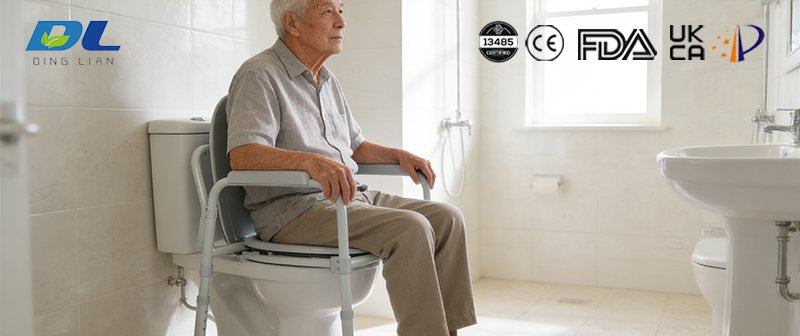
Why Certifications Are So Easily Misunderstood
Elderly care equipment sits in a gray zone between consumer products and regulated medical devices. Items such as commode chairs, toilet safety frames, and bathroom handrails appear simple, yet they directly support users with limited mobility.
This creates a market where documentation is abundant, but understanding is limited — especially for first-time importers.
What Certifications Are Supposed to Do
At their core, certifications serve three different purposes:
- To demonstrate compliance with market regulations
- To confirm product-level safety testing
- To ensure manufacturing consistency over time
The problem arises when buyers treat all certificates as equal, without understanding which risk each one addresses.
Certifications That Actually Matter
ISO 13485 — Quality Management for Medical Devices
ISO 13485 is often misunderstood as a “medical-only” requirement. In practice, it plays a crucial role for elderly care equipment used in institutional environments.
This system focuses on:
- Process control across production stages
- Traceability of materials and components
- Risk management during design and manufacturing
For products like commode chairs, ISO 13485 helps ensure that the unit shipped today performs the same as the unit shipped six months later.
ISO 9001 — Manufacturing Consistency
ISO 9001 does not replace product testing, but it establishes a baseline for operational discipline. It reduces variation between batches — a key concern for buyers supplying care facilities.
Without a functioning quality system, sample approval loses its meaning.
CE and UKCA — Market Access, Not Product Quality Guarantees
CE and UKCA markings indicate conformity with essential safety and regulatory requirements. They are mandatory for market access in many regions, but they are often misinterpreted as proof of superior quality.
In reality, these markings confirm compliance — not durability under long-term use.
FDA Registration — Administrative Transparency
FDA registration is frequently mistaken for FDA approval. For most elderly care products, registration confirms that the manufacturer and product are listed within the regulatory system.
It does not imply that the product has undergone FDA performance testing.
Certifications That Are Often Overvalued
Isolated Test Reports Without Context
Single load tests or short-term evaluations provide limited insight into how products behave after repeated use. These reports are often generated using ideal conditions that do not reflect daily operation in care facilities.
Certificates Without Manufacturing Scope
Some documents apply only to specific product models or production sites. Buyers who fail to check scope details may assume coverage that does not exist.
Why Certification Alone Never Replaces Engineering
Certifications do not design products. Engineering decisions — material thickness, joint structure, surface treatment — determine whether a product remains safe after years of use.
This is especially critical for transfer-support products such as commode handrails, where stability directly affects user safety.
How Experienced Buyers Interpret Certificates
Seasoned procurement teams do not ask whether a factory has certificates. They ask how those certificates are implemented.
- Are inspections embedded in daily production?
- Are materials traceable back to suppliers?
- Is corrective action documented when issues occur?
These questions matter more than the number of logos on a document.
Certification vs. Real-World Performance
| Aspect | Certificate Focus | Operational Reality |
|---|---|---|
| Testing | Short-term verification | Long-term fatigue behavior |
| Compliance | Market entry | Ongoing safety |
| Documentation | Static reports | Process discipline |
Why Buyers Still Need to Ask the Right Questions
Certificates reduce risk, but they do not eliminate it. Buyers entering this industry should evaluate how certifications align with actual product usage.
Reviewing a supplier’s certificate framework — such as the one outlined on our certificates page — is only the starting point.
The Manufacturer’s Role Beyond Certification
At Dinglian, certifications support — but do not replace — design responsibility. Our approach focuses on:
- Designing for repeated institutional use
- Material selection based on humid environments
- Consistent output across long-term supply
- Transparent communication with buyers
FAQ — Common Certification Questions
Which certificates are most important?
CE, UKCA, ISO 13485, ISO 9001, FDA registration, and relevant patent protections are commonly referenced depending on the market.
Do certificates guarantee product durability?
No. They confirm compliance and process control, not long-term performance under repeated use.
How should buyers evaluate beyond certificates?
Review material choices, design margins, production consistency, and post-shipment support.
Final Advice for New Industry Entrants
Certifications matter — but understanding what they actually protect you from matters more.
For buyers entering the elderly care equipment sector, learning to interpret certificates correctly is a critical step toward long-term success.
If you would like practical guidance on evaluating suppliers and documentation, feel free to contact us for experience-based insight.