
How Daily Usage Patterns Shape Elderly Care Equipment Design
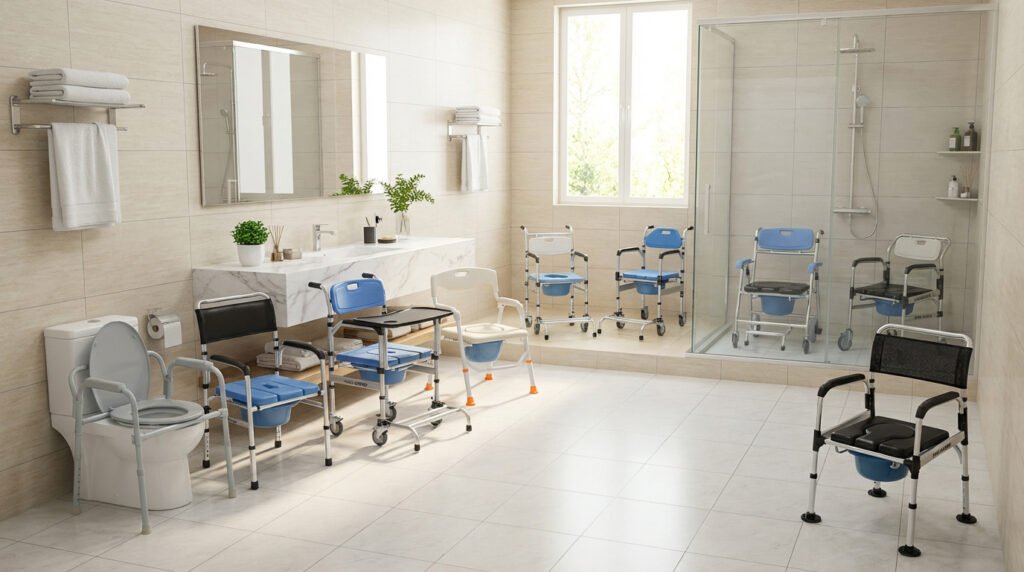
How Daily Usage Patterns Shape Elderly Care Equipment Design
Most procurement conversations happen one product at a time — a shower chair inquiry today, a commode question next week, a walker order the month after. A resident’s actual day doesn’t work that way. It’s one continuous sequence: out of bed, across the room, into the bathroom, back again, repeated with small variations from morning until night. The friction that actually causes falls and caregiver strain tends to show up not inside any single product, but at the handoff points between them — the moment someone lets go of a bedside rail and reaches for a walking frame, or stands up from a shower seat and pivots toward a towel rail that isn’t quite where they expected it.
This is worth walking through as a day, not as a catalog, because that’s closer to how the equipment actually gets judged by the people using it.
Why a Single Day Matters More Than a Single Product
A distributor who evaluates a shower chair in isolation is asking “does this chair do its job.” A distributor thinking in terms of daily patterns asks a slightly different question: “does this chair hand the user off safely to whatever comes next.” That second question is harder to answer from a spec sheet alone, but it’s usually the one that predicts whether a facility keeps reordering the same product line or quietly switches suppliers within a year.
The Morning Transfer: Where the Day’s Risk Actually Starts
The first movement of the day — going from lying down to standing, often while still groggy — carries more risk than most of what follows, simply because balance and coordination haven’t fully engaged yet. A bedside handrail earns its place here not through any single dramatic feature, but through small details: a height that lets someone pull up in stages rather than in one motion, and a mounting surface stable enough that the user trusts it on the first push, not just the tenth.
Get this moment wrong, and everything downstream — the walk to the bathroom, the transfer onto a shower seat — starts from a worse position, both literally and in terms of the user’s confidence for the rest of the routine.
Bathing: A Short Window With Disproportionate Risk
Bathing takes up a small fraction of the day but accounts for a disproportionate share of the close calls caregivers actually mention — wet tile, a tub lip that’s higher than it looks, a moment of standing balance right when the floor is at its slipperiest. The pattern that matters here isn’t really about the shower chair’s specifications in isolation; it’s about whether the seat height, grip, and stability were chosen with that specific short, high-risk window in mind, rather than adapted from a general-purpose seating design.
Toileting: Two Different Needs Wearing the Same Name
Toileting is where daily-pattern thinking matters most, because “commode” gets used as a catch-all term for two genuinely different situations. One is proximity — getting the toilet closer to the bed for someone who can’t safely walk the distance, especially at night. The other is transfer support — helping someone who can reach the bathroom independently manage the stand-up and sit-down motion at a fixed toilet without strain. Treating these as interchangeable is one of the more common sourcing mistakes we see, because the product that solves one problem well often isn’t the right fit for the other.
Which one applies depends entirely on where this moment sits in that resident’s specific daily pattern — how far they’re actually walking, how confident their balance is once upright, and how much of the transfer a caregiver is currently doing manually. You can see how this plays out across different configurations on our commode chair range, which covers both the proximity-focused and transfer-focused versions of this need.
| Daily Moment | Primary Risk | Product Role | Handoff Point to Watch | Sourcing Note |
|---|---|---|---|---|
| Morning transfer (bed to standing) | Balance not yet engaged | Bedside handrail, staged support | Letting go of the rail before reaching a walking aid | Check pull-up height, not just weight rating |
| Bathing | Wet, slippery, short window | Shower seat sized for the transfer, not just seating | Standing back up while still wet | Grip and stability matter more than cushioning here |
| Toileting | Distance or transfer strain, depending on the case | Bedside commode or transfer-support commode | Confusing proximity need with transfer need | Match to walking distance and balance, not to habit |
| Walking between rooms | Mixed mobility levels through the day | Cane indoors, rollator or frame further afield | Switching support type mid-routine | Plan for both, not just the more visible one |
Walking Between Rooms: The Mixed-Use Reality
Few residents use the same level of support all day. Someone might manage fine with a cane moving between rooms, but need a more stable rollator or frame for a longer trip to a dining hall or an outdoor visit. This mixed pattern is easy to miss if a facility is only stocking for the “average” mobility level of its residents, rather than planning for the fact that most residents actually move between two or three support levels depending on the specific trip.
The practical implication for a distributor is straightforward, even if it’s rarely stated this way: stocking a single mobility aid category per resident often undersells what that resident actually needs across a full day, while stocking too broadly across every category wastes both storage and budget. Understanding the specific mixed-use pattern of the population you’re serving tends to matter more than defaulting to whichever category currently has the strongest margin.
Evening Transfer and the Return to Bed
The evening version of the morning transfer carries its own version of the same risk, usually compounded by fatigue rather than grogginess. For residents with more limited mobility, this is often where the equipment chain gets longest — wheelchair to commode, commode to recliner, recliner back to bed — and where a mismatch at any single handoff point creates the kind of slow, repeated strain that eventually shows up as a caregiver’s back injury rather than a single dramatic incident.
This is also where the “one product at a time” mindset breaks down most visibly. A facility can have every individual piece of equipment technically in good condition and still have a genuinely difficult evening routine, simply because nobody evaluated how the pieces actually connect to each other in sequence.
Why This System View Changes What You Ask a Manufacturer
Once a distributor starts thinking in terms of a resident’s full day rather than individual product categories, the questions worth asking a manufacturer shift accordingly. Instead of asking whether each product meets its own certification and load requirements — which still matters, but is only half the picture — it becomes worth asking whether the same factory can maintain consistent design language and compatible spare parts across categories, so that a bedside handrail, a shower seat, and a commode chair from the same supplier actually work together as a coherent system rather than as unrelated purchases that happen to share a shipping container.
This is the area where Zhongshan Dinglian manufacturer has deliberately built its production around, treating shower chairs, commode chairs, walking aids, and related bedside equipment as a connected product family rather than isolated lines developed independently of each other. As a factory controlling design and production in-house, that connected approach tends to simplify things meaningfully for distributors managing inventory and after-sales support across a full elderly-care catalog, rather than juggling separate suppliers with inconsistent quality standards for each category.
If you want to see how that production setup actually works, our equipment page covers the manufacturing side directly, and our company background page goes further into how Dinglian factory approaches this cross-category design consistency as a long-term rehabilitation equipment manufacturer.
Final Thoughts
Equipment chosen product by product tends to work fine in isolation and still create friction in practice, because the actual risk in daily care lives at the handoff points — the transitions between one product and the next — more than inside any single item. Thinking through a resident’s full day, from the first transfer out of bed to the last one back into it, tends to surface sourcing decisions that a category-by-category comparison would miss entirely.
If you’re planning a catalog structure around a specific resident population, or want to talk through how these categories fit together for your market, our team can walk through the specifics directly — you’re welcome to contact us to discuss your situation.