
Repetitive Movement in Care Equipment Why Do Chairs Walkers and Handrails Wear Out
In daily care environments, equipment failure rarely comes from sudden overload. Instead, most issues develop slowly through repetitive movement. Chairs, walkers, and handrails are used hundreds or even thousands of times each week, often by different users, under varying conditions. Over time, these repeated motions become the main reason structural wear appears.
This article explains how repetitive movement affects care equipment in real facilities, drawing from industry practice, public standards, academic research on fatigue behavior, and feedback from long-term buyers. The goal is to help procurement teams understand what really determines service life beyond appearance and initial inspection.
What Counts as Repetitive Movement in Care Facilities
Repetitive movement is not limited to walking motion. In care settings, it includes pushing, pulling, folding, lifting, locking, and repositioning equipment throughout the day. A rollator may be folded dozens of times. A handrail may support body weight repeatedly during transfers. Each action introduces micro-stress into the structure.
Products classified as walking aids are particularly exposed. They are frequently moved between rooms, adjusted to different heights, and leaned on from multiple angles. These real-use patterns are often underestimated during product selection.

Why Repetition Causes More Damage Than Heavy Loads
1. Material Fatigue Builds Invisibly
Engineering research shows that materials fail more often from fatigue than from overload. Even moderate forces, when applied repeatedly, can weaken joints, welds, and fasteners. Aluminum alloys and thin-wall steel tubing are especially sensitive to cyclic stress.
In chairs and handrails, this often appears as loosened screws, subtle frame distortion, or reduced stability long before visible cracks form. By the time damage is obvious, structural integrity has already declined.
2. Movement Direction Changes Stress Points
Unlike static testing, real use introduces forces from multiple directions. Users rarely apply weight perfectly vertically. Side loading, twisting, and uneven force distribution accelerate wear at connection points. This is common in toilet and commode-related equipment.
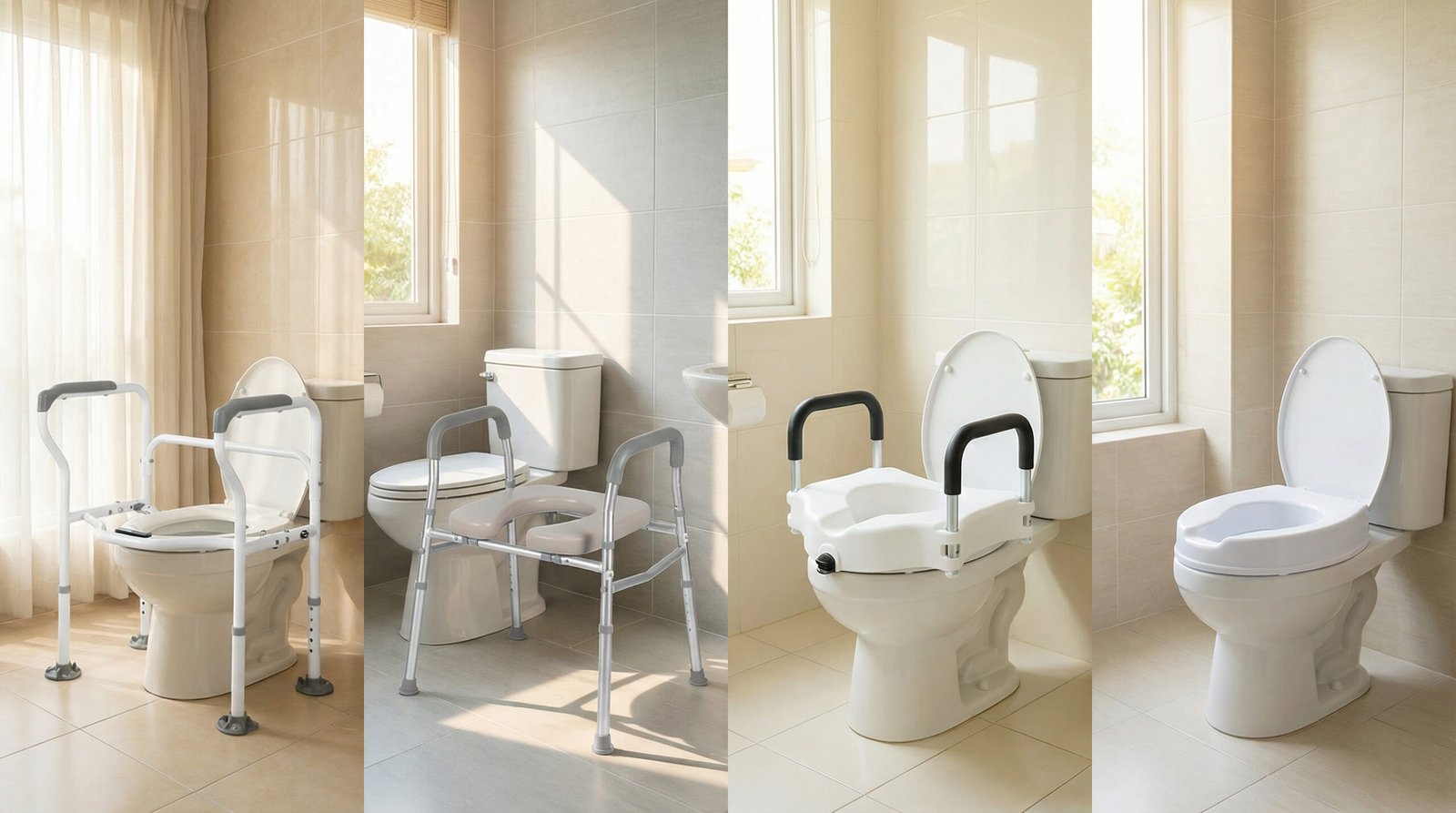
3. Surface Degradation from Constant Contact
Hand grips, armrests, and support rails experience constant friction. Combined with cleaning chemicals and moisture, surface coatings gradually thin. Once protective layers degrade, corrosion and material fatigue accelerate.
Common Failure Patterns Buyers Report
Feedback from procurement discussions and care managers highlights recurring issues linked to repetitive movement:
- Gradual instability despite passing initial safety checks
- Increased maintenance frequency after the first year
- Unexpected noise or looseness at joints
- Shortened service life compared to expectations
How Design Choices Influence Long-Term Performance
Repetitive movement resistance depends on more than material type. Design details such as joint reinforcement, wall thickness transitions, and load distribution geometry play a decisive role.
| Design Factor | Impact on Repetitive Use |
|---|---|
| Joint reinforcement | Reduces micro-movement and loosening |
| Material thickness consistency | Prevents stress concentration |
| Fastener selection | Improves long-term stability |
Why Experienced Buyers Look Beyond Appearance
For large buyers, inspection results alone are not enough. They evaluate how products perform after prolonged use. Compliance documentation, such as those shown on the certification page, provides baseline assurance, but real durability comes from design execution.
At Dinglian (Zhongshan) Rehabilitation Equipment Co., Ltd., product development reflects real facility behavior. As a company closely involved in engineering, production, and supply coordination, Dinglian evaluates repetitive movement as a core design factor rather than an afterthought.
This philosophy is especially evident in products such as commode handrails, where repeated load cycles directly affect user safety.
What This Means for New Market Entrants
Buyers entering the rehabilitation equipment market often focus on unit cost and specifications. However, repetitive movement is the hidden variable that determines long-term value. Equipment designed only for static testing may struggle in daily care use.
Selecting partners with experience in real-world application helps reduce replacement cycles, maintenance costs, and inspection risks.
For technical discussions, specification clarification, or sourcing inquiries, you are welcome to contact our team.