
What are the key differences between a rollator and an upright walker?

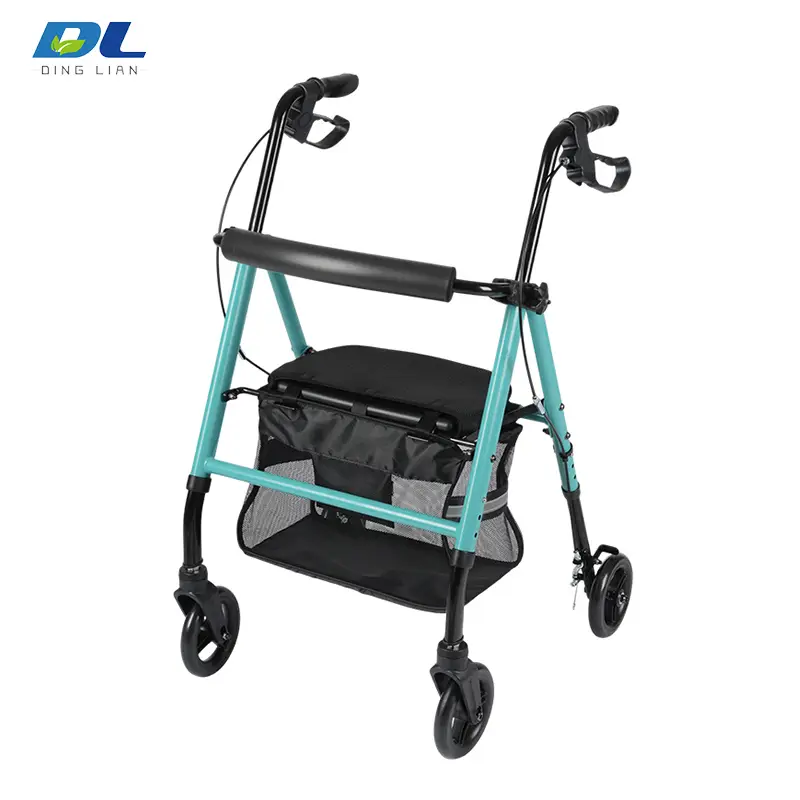
What really separates a rollator from an upright walker?
The main difference is not simply the number of wheels or the height of the frame. A traditional rollator supports the user mainly through the hands and standard handgrips, while an upright walker shifts much of that support toward the forearms and elbows. That changes the user’s walking position, steering method, frame geometry, and overall product footprint. For buyers, the practical question is therefore not which design is “better,” but which support architecture matches the intended user group, care environment, price level, and distribution market.
This distinction matters when building a product range. A conventional rollator can be easier to maneuver, easier to fold, and easier to position across different price segments. An upright walker can offer a more elevated support position for users who struggle with conventional handgrip positioning or tend to lean forward. The two products may look similar in a catalog, but they solve different problems.
1. Where does the user’s weight actually go?
This is the first point I would discuss with a distributor before comparing models. A traditional rollator normally uses a pair of handgrips connected to the frame and braking system. The user places the hands on the grips while walking, steering, slowing down, and stopping. The frame carries the device’s structural load, but the user’s upper-body contact is concentrated around the hands and wrists.
An upright walker changes that contact area. Its forearm platforms or elbow supports create a larger support surface between the user’s upper limbs and the frame. The handles are usually positioned higher and closer to the user’s natural upright posture. This does not mean that an upright walker automatically eliminates all physical strain. It means the product is designed around a different load path.
That difference has a direct manufacturing consequence. Once the support moves upward from the handgrip to the forearm area, the frame must manage forces at a different height. Tube geometry, joint location, armrest mounting, brake routing, adjustment mechanisms, and lateral stability become more important. A manufacturer cannot simply take a traditional rollator and raise the handles without reconsidering the structure.
Why this matters to a buyer
If your target market includes users with limited hand strength, wrist discomfort, or a strong preference for an upright walking position, an upright design may occupy a useful premium segment. But if your buyers mainly need a practical daily mobility aid for general walking assistance, a conventional rollator may offer a simpler product proposition and broader market coverage.
The purchasing mistake is to compare the two products only by seat, basket, wheel size, or selling price. Those are visible features. The real differentiation starts with the user’s contact point with the frame.
2. Why does posture change between the two designs?
A conventional rollator is normally adjusted so that the handgrips sit around the user’s wrist level when the arms hang naturally. This encourages a moderate elbow bend during use. The user remains behind or slightly within the rear portion of the rolling frame and controls movement through the handgrips and brakes.
An upright walker takes a different approach. Its forearm supports and elevated handles are intended to let the user position the upper body more vertically while walking. The frame is generally designed so the user can move more centrally within the support structure rather than reaching forward toward conventional handgrips.
For procurement teams, the important point is that posture is not just a comfort feature. It affects the whole product architecture. Raising the support position changes the center of the user’s interaction with the frame. The manufacturer then has to consider frame width, wheelbase, arm-support height, braking access, folding points, and resistance to side-to-side movement.
This is why upright walkers are often larger than lightweight standard rollators. More structure is needed around the upper support area, and the frame has to remain stable while the user applies force higher above the wheel contact points.
A practical distinction for product positioning
A standard rollator is often easier to position as an everyday mobility product. An upright walker is more naturally positioned as a posture-oriented or forearm-supported mobility solution. That difference can influence the distributor’s sales channel, product education requirements, packaging, warranty expectations, and even the amount of showroom space needed.
3. How do the two designs differ in maneuverability?
Maneuverability is where the theoretical advantage of an upright walker can meet a practical limitation. A conventional rollator can be designed around a relatively compact wheelbase and simple handgrip control. Many models use swivel front wheels, hand brakes, a folding frame, and a seat without adding a large upper support structure.
The current Dinglian Rollator range illustrates how much variation can already exist within the conventional category. The website lists the DL-7072 at 5.9 kg with 4.5-inch wheels, while the DL-7078A is 7.55 kg with 6-inch wheels. Both use aluminum alloy frames and have a 150 kg load-bearing capacity, but their dimensions and intended handling characteristics differ. :chatgpt-content-reference{index=”1″}
For a distributor, this is important because “rollator” is not one single specification. A lightweight 4.5-inch-wheel model and a larger 6-inch-wheel model can sit in different applications even though both belong to the same product family.
An upright walker can provide a different support experience, but its additional forearm structure may increase width, weight, or turning radius. That does not make it a poor product. It simply means the product should be evaluated against the environment where it will actually be used.
Indoor care environments versus outdoor mobility
For nursing facilities, rehabilitation centers, and home-care distributors, doorway width and turning space can become more important than a brochure’s feature count. A product that performs well in an open showroom may feel cumbersome around beds, bathroom entrances, elevators, narrow corridors, or vehicle trunks.
This is one reason I would not recommend replacing a conventional rollator category with upright walkers simply because upright positioning sounds more advanced. A product portfolio should cover the environments buyers actually serve.
4. What does the frame structure tell you about product quality?
For procurement, the frame deserves more attention than cosmetic accessories. The basic questions are straightforward: What material is used? What tube dimensions are selected? Where are the folding joints located? How are the wheels mounted? How is the braking force transferred? How is the height adjustment locked?
Traditional rollators give manufacturers several structural routes. Aluminum alloy is common when weight reduction and corrosion resistance are important. High-carbon steel can provide a different balance between structural rigidity, material cost, and finished weight. The choice should be evaluated together with tube thickness, joint design, surface treatment, and the intended load rating rather than judged from material name alone.
Dinglian’s current website provides a useful example of this product-level variation. The DL-7071T uses a high-carbon steel frame and is listed at 8.25 kg net weight with a 150 kg load-bearing capacity. The DL-7072 uses aluminum alloy and is listed at 5.9 kg with the same 150 kg capacity. The difference is not simply “steel versus aluminum”; the frame architecture and intended product positioning also matter. :chatgpt-content-reference{index=”2″}
An upright walker introduces additional structural considerations because the forearm supports sit higher and can create greater leverage against the frame. For a buyer, that means asking for stability verification under realistic loading conditions rather than relying only on the nominal user weight printed on the specification sheet.
The manufacturing detail buyers often overlook
A frame can look strong and still perform poorly if the adjustment mechanism develops play, the folding joint is inconsistent, or the brake cable routing creates interference. In repeated-use equipment, small tolerance differences can become noticeable after hundreds or thousands of operating cycles.
That is why quality control should not stop at final appearance inspection. Incoming tube material, cutting accuracy, bending consistency, welding or joining quality, hole positioning, coating, assembly torque, wheel alignment, brake operation, and folding performance all contribute to the final product.
5. Which product is easier to source for a broader distributor market?
If the goal is broad market coverage, the conventional rollator usually has an advantage because the category already includes many familiar configurations: lightweight aluminum models, steel-frame models, compact indoor models, larger outdoor models, models with seats, models with baskets, and different wheel sizes.
That variety gives distributors more room to build a product ladder. One model can target price-sensitive channels, another can target general home care, and a heavier or larger configuration can address users who need greater structural capacity.
The current Dinglian catalog demonstrates this range. The DL-7077D is listed at 7 kg net weight with a 150 kg load-bearing capacity, a 47–56.5 cm seat height, and 6-inch wheels. The DL-7078A is 7.55 kg with a 56 cm seat height and 6-inch wheels. The DL-7078B is a heavier aluminum model at 10.3 kg with a 58 cm seat height. These are not minor variations for procurement; they can be positioned for different buyer requirements. :chatgpt-content-reference{index=”3″}
An upright walker, by comparison, normally requires a more specific explanation at the point of sale. The distributor may need to explain why forearm support matters, how the user should position the arms, how braking is accessed, and why the product has a different frame footprint.
That can be a commercial advantage in a specialist rehabilitation channel, but it can also increase sales training requirements. A buyer should therefore evaluate not only factory price but also how much product education the downstream channel can realistically support.
6. How should buyers compare rollators and upright walkers during supplier evaluation?
I would not start with the question “Which one has more features?” Start with the intended use case, then work backward toward the frame.
| Purchase Factor | Traditional Rollator | Upright Walker | Main Engineering Concern | Buyer Question |
|---|---|---|---|---|
| User contact | Handgrips and hand brakes | Forearm supports plus handles | Support position and frame leverage | Where does the user apply force? |
| Posture | Moderately upright with conventional hand position | Designed around a more upright torso | Armrest height and frame geometry | Does the structure support the intended posture? |
| Maneuverability | Usually easier to keep compact | Can require a wider support structure | Wheelbase, width and turning behavior | Where will it be used? |
| Product range | Broad range of weights, sizes and wheel options | More specialized positioning | Configuration and component complexity | Does it fill a real gap in the catalog? |
| Procurement risk | Usually easier to standardize across channels | Requires closer user-fit evaluation | Adjustment, stability and braking | Can the supplier document consistent production? |
This table is more useful than comparing feature counts because it connects the product architecture to the buyer’s commercial decision. If the target market is general home care and daily mobility, a conventional rollator may be the more efficient core product. If the market specifically requests forearm-supported walking or upright positioning, an upright model deserves separate consideration.
7. What should distributors inspect before placing a bulk order?
A sample inspection should go beyond checking whether the product looks attractive. For a rollator or upright walker, I would divide the inspection into five areas: frame, adjustment, braking, wheels, and folding structure.
Frame and joints
- Check whether welded or joined areas are consistent across samples.
- Look for excessive movement at folding joints and adjustment points.
- Confirm that tube surfaces and coating remain consistent after forming.
- Verify the actual frame dimensions against the approved drawing.
Brakes and wheels
Brakes deserve particular attention because they combine mechanical components, cable routing, handle position, and wheel response. A brake that works correctly on one sample is not enough. The manufacturing process needs to maintain the same adjustment and installation quality across production batches.
Wheel alignment also affects the user’s perception of quality. If the front wheels do not track consistently, the user may need to correct the direction continuously. For distributors, that can become an after-sales issue even when the frame itself remains intact.
Folding and adjustment
Folding mechanisms should be tested repeatedly rather than demonstrated once. Height-adjustment holes, locking pins, knobs, cables, and quick-release components should be checked for consistent operation. For upright walkers, the same principle applies to forearm-support adjustment. More adjustment points mean more opportunities for tolerance variation, so the supplier’s process control becomes more important.
8. How does material selection affect the final product?
For standard rollators, aluminum alloy is attractive when the market values lower carrying weight, corrosion resistance, and easier handling. Steel can make sense where structural rigidity, cost control, or a particular frame configuration is more important. But neither material should be evaluated independently from tube thickness, welding quality, surface treatment, wheel mounting, and load design.
This is particularly relevant when comparing an aluminum rollator with an upright walker. Buyers sometimes assume that the upright model must be heavier simply because it looks larger. The real weight difference depends on the frame construction, support components, wheel system, seat, accessories, and adjustment mechanisms.
For example, Dinglian’s current website lists several aluminum rollators between roughly 5.9 kg and 10.3 kg net weight, demonstrating how much variation can exist inside one material category. :chatgpt-content-reference{index=”4″}
That is why a professional RFQ should request the complete specification rather than simply asking for “an aluminum rollator.” The buyer should define the required load capacity, frame dimensions, seat height, wheel diameter, folding dimensions, packaging dimensions, finish, and accessories.
9. Which one should a distributor add to the product portfolio?
If your customers mainly include general medical supply distributors, pharmacies, home-care channels, and elderly-care retailers, I would normally treat the conventional rollator as the broader base category. It can cover more everyday mobility scenarios without requiring a highly specialized explanation.
An upright walker makes more sense when there is clear demand for forearm support, upright positioning, or a product designed around users who find conventional handgrips less suitable. In that situation, it should be positioned as a distinct product class rather than simply presented as a more expensive version of a rollator.
This distinction can also help with inventory planning. A distributor does not necessarily need ten similar rollators. A better range may consist of a compact lightweight model, a general-purpose model, a larger outdoor-oriented model, and a specialized upright model if the local market supports it.
Dinglian’s current Rollator Walker range can be reviewed alongside the wider Our Equipment portfolio when evaluating how different mobility products fit into a broader rehabilitation equipment catalog.
10. What is the most useful way to make the final purchasing decision?
I would use a simple four-step decision process.
- Define the user interaction. Decide whether the user primarily needs handgrip support or forearm-supported positioning.
- Define the environment. Measure the practical requirements for corridors, doorways, elevators, vehicles, storage, and outdoor surfaces.
- Define the product economics. Compare factory price, packaging volume, shipping weight, expected retail position, accessories, and after-sales exposure.
- Verify production consistency. Check samples, drawings, material specifications, braking, folding, adjustment, load testing, and packaging before confirming a larger order.
The last step is where supplier selection becomes more important than product selection. Two factories can offer products that look almost identical in photographs while producing very different results in repeated use. For B2B buyers, consistency between the approved sample and mass production is usually more valuable than adding another accessory to the specification sheet.
Conclusion: compare the support architecture, not just the appearance
A traditional rollator and an upright walker belong to the same broad mobility-aid market, but they are built around different user interaction models. The traditional rollator uses conventional handgrips and generally offers a compact, familiar, highly versatile configuration. The upright walker moves the primary support area toward the forearms and creates a different relationship between the user, frame, brakes, wheels, and posture.
For buyers, the practical lesson is simple: do not judge the two categories only by weight, wheel size, seat design, or selling price. Look at where the user places force, how the frame reacts to that force, how easily the product moves through the intended environment, and whether the manufacturer can keep those characteristics consistent from sample to production.
If you are evaluating a supplier rather than purchasing a single unit, the next step should be a specification-level discussion. Dinglian’s About Us page provides background on the company and manufacturing operation, while buyers with a specific rollator or upright-walker requirement can use the Contact Us page to discuss configuration, quantity, OEM requirements, packaging, and market-specific specifications.
The strongest product choice is rarely the one with the longest feature list. It is the one whose structure, user support method, manufacturing process, and commercial positioning all make sense for the market you are actually supplying.