
What is the best height to set a rollator?
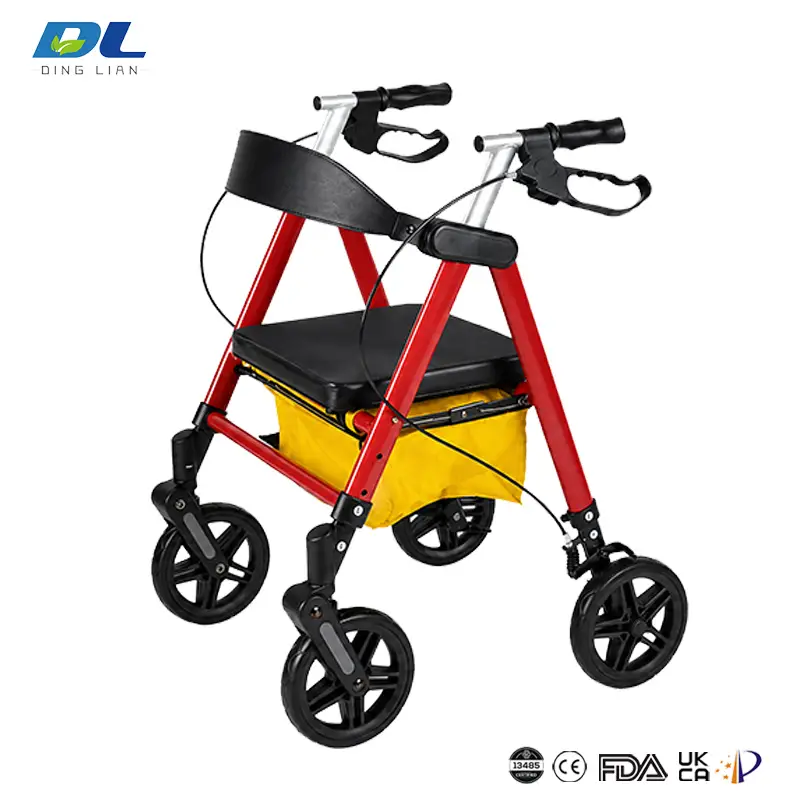
How Handle Height Affects Rollator Fit and Daily Use
The best rollator handle height is generally around the user’s wrist crease when standing upright, wearing their usual shoes, and letting both arms hang naturally. Once the user holds the grips, the elbows should remain slightly bent. For buyers, however, correct fitting is only one part of product selection. The actual handle-height range, adjustment positions, seat height, frame dimensions, and locking design all influence whether a rollator is suitable for its intended users.
For example, Zhongshan Dinglian Rehabilitation Equipment Co., Ltd. offers different four-wheel models with handle heights ranging from 75 cm to 99 cm. These models do not all serve the same purpose. Their differences in material, weight, seat dimensions, and wheel size give distributors more than one option when building a product range.
What Is the Best Height for a Rollator Handle?
For most users, a practical starting point is to set the handle grips level with the wrist crease while standing naturally. The user should wear the shoes normally used when walking with the rollator. After gripping both handles, the elbows should have a slight bend rather than being fully straight or sharply flexed.
This method is more reliable than selecting a rollator based only on the user’s total body height. Arm length, shoulder position, footwear, and natural walking posture can all affect the final setting.
Why wrist-level measurement is a useful starting point
When the handles are too high, the user may need to raise the shoulders or hold the arms in an unnatural position. When they are too low, the user may lean forward or bend the back more than necessary. Neither position should be treated as an acceptable compromise simply because the handles can be adjusted.
The wrist-level method provides a practical first measurement. It should then be checked by having the user hold the grips and stand naturally. The final position should allow a comfortable arm angle and a stable walking posture.
For a distributor, this also provides a clear way to explain product fitting to dealers and customers. Instead of relying on a vague description such as “adjustable for different heights,” the supplier can provide the actual minimum and maximum grip heights and explain how users should check the fit.
Why a universal user-height chart is not enough
A product may be advertised as suitable for users within a particular height range, but two people of the same height can have different arm lengths. One may find the handles comfortable at a middle setting, while another may need a higher or lower position.
That is why product specifications should state the actual floor-to-grip measurement. A user-height recommendation can still be included as a reference, but it should not replace the physical dimensions of the product.
How Do You Set the Rollator Height Correctly?
The fitting process is straightforward, but it should be carried out consistently. Buyers supplying rollators to retailers, hospitals, or care facilities can use the following procedure as a basic fitting reference.
A practical handle-height adjustment procedure
- Wear normal walking shoes. The measurement should reflect the footwear the user will normally wear.
- Stand upright. Keep the shoulders relaxed and allow both arms to hang naturally at the sides.
- Check wrist level. The handle grips should be approximately level with the wrist crease.
- Adjust both sides equally. Make sure the left and right handles are set to the same height.
- Grip the handles. Check that the elbows remain slightly bent and the shoulders are not raised.
- Check the locking mechanism. Confirm that both handles are securely locked before the user starts walking.
- Test the brakes. Make sure the brake levers operate correctly and the cables are not trapped or excessively stretched.
Users should not exceed the manufacturer’s adjustment limits or use a rollator with a loose handle. If the user cannot achieve a comfortable position within the available range, a different model or professional fitting assessment may be necessary.
Why left-right consistency matters
Both handles should normally be set at the same height. If one side is higher than the other, the user may hold the rollator asymmetrically. This can make the grip feel uneven and may affect the user’s walking position.
For this reason, the adjustment mechanism should make it easy to identify matching positions on both sides. Clear adjustment holes, visible locking buttons, and consistent markings can help users and caregivers avoid setting errors.
What Happens When a Rollator Is Set Too High or Too Low?
An incorrect handle setting can affect more than comfort. It may change how the user positions their upper body, distributes weight through the hands, and controls the rollator during movement.
When the handles are too high
If the grips are above a comfortable level, the user may raise the shoulders or bend the elbows less naturally. Some users may also find it harder to apply controlled pressure through the handles. This is especially relevant when a rollator is used frequently over longer periods.
For product buyers, the issue is not simply whether a tall setting is available. The handle should remain structurally secure at the highest position, and the brake cables should continue to operate without obstruction.
When the handles are too low
Handles that are too low can encourage the user to lean forward or bend the upper body. The user may then walk in a less upright position and find it harder to maintain a comfortable grip.
A wide adjustment range is useful only when the frame remains appropriate for the user at each setting. If the user consistently needs the handle at the very top or bottom of its range, buyers should consider whether another frame size would provide a better overall fit.
How Do Real Rollator Dimensions Help Buyers Choose the Right Model?
Actual product measurements make the discussion more useful for distributors. They show how different models address different fitting requirements instead of treating all adjustable rollators as interchangeable.
The following comparison uses the floor-to-grip height confirmed for Dinglian’s models. The figures are product specifications supplied for these models, not estimates based on general industry dimensions.
Comparing handle-height ranges across Dinglian models
| Model | Frame material | Floor-to-grip height | Adjustment positions | Maximum user weight |
|---|---|---|---|---|
| 7071T / 7071TJ | High-carbon steel | 80–90 cm | 5 positions | Up to 200 kg |
| 7072 | Aluminum alloy | 75–99 cm | 6 positions | 150 kg |
| DL-7077D | Aluminum alloy | 80–96 cm | 6 positions | 150 kg |
| DL-7078A | Aluminum alloy | 84–97 cm | 6 positions | 150 kg |
| DL-7078B | Aluminum alloy | 82–97 cm | 7 positions | 150 kg |
| DL-7078C | Aluminum alloy | 84–96.5 cm | 6 positions | 150 kg |
One detail stands out: the 7072 has the widest stated handle-height range in this group, from 75 cm to 99 cm. It also has six adjustment positions. By comparison, the 7071T and 7071TJ cover 80–90 cm with five positions.
This does not automatically make the 7072 the better product for every customer. A distributor serving users who need a wider range of grip heights may value the 7072’s broader adjustment range. A buyer prioritizing a steel frame and a higher stated weight capacity may want to assess the 7071T or 7071TJ instead.
The DL-7077D and DL-7078 series provide additional options within the aluminum-alloy range. Their handle-height specifications overlap, but their frame dimensions, seat heights, product weights, and configurations differ. These details should be considered before selecting a model for a particular sales channel.
Why adjustment range and adjustment positions should be compared separately
Two products may have similar minimum and maximum heights but different numbers of adjustment positions. Conversely, a product may offer more positions without providing a substantially wider total range.
Buyers should therefore compare three things: the lowest grip height, the highest grip height, and the number of available settings. Where possible, request the distance between adjacent settings as well. This helps explain how precisely the user can adjust the handles.
For product specifications and sample approval, the measurement reference should remain consistent: floor to the same point on the handgrip. This avoids confusion when comparing products from different manufacturers.
Why Should Seat Height Be Compared Separately from Handle Height?
Handle height and seat height are two different measurements. Handle height affects the user’s arm position while walking. Seat height affects how the user sits, positions their feet, and gets up again. A rollator can provide a suitable grip height but still have a seat that does not match the user’s leg length.
This distinction is important when comparing Dinglian’s models. Some models have a relatively wide handle-height range, while their seat dimensions and frame configurations are quite different.
Comparing seat heights across selected models
| Model | Floor-to-grip height | Seat height | Overall dimensions (L × W) | Product weight |
|---|---|---|---|---|
| 7071T / 7071TJ | 80–90 cm | 50–51 | 60 × 57 cm | 8.15 kg |
| 7072 | 75–99 cm | 42–54.5 cm | 60 × 75 cm | 5.9 kg |
| DL-7077D | 80–96 cm | 47–56.5 cm | 61 × 57.5 cm | 7.0 kg |
| DL-7078A | 84–97 cm | 56 cm | 70 × 52.5 cm | 7.55 kg |
| DL-7078B | 82–97 cm | 58 cm | 68 × 61.5 cm | 10.3 kg |
| DL-7078C | 84–96.5 cm | 57 cm | 70 × 57 cm | 7.2 kg |
The 7072 and DL-7077D both offer adjustable seat heights. The 7072 has a stated seat-height range of 42–54.5 cm, while the DL-7077D ranges from 47–56.5 cm. This gives buyers a useful comparison when selecting products for users who may need different sitting positions.
The DL-7078A, DL-7078B, and DL-7078C have stated seat heights of 56 cm, 58 cm, and 57 cm respectively. Their seat heights are relatively close, but the overall dimensions and product weights differ. A buyer should not assume that these models are interchangeable simply because their grip-height ranges overlap.
What seat height means for the user
A seat that is too high may make it difficult for a user to place both feet comfortably on the floor. A seat that is too low may require more effort to stand up, depending on the user’s strength and mobility. The appropriate position also depends on the user’s leg length and the way they transfer between walking and sitting.
For distributors supplying care facilities, this is worth checking during sample evaluation. Staff may be responsible for helping different users adjust or use the equipment. A model that fits the intended user group more consistently can reduce the need for repeated product changes.
How Do Material, Weight and Wheel Size Affect Model Selection?
Handle height is only one part of a rollator’s specification. Frame material, product weight, wheel diameter, seat design, and folding dimensions also influence which model is suitable for a particular market.
Dinglian’s product range provides a practical example of how these factors can differ even when products share a similar purpose.
Steel and aluminum-alloy frame options
The 7071T and 7071TJ use high-carbon steel and have a stated maximum user weight of 200 kg. Their product weight is 8.15 kg, and the frame tube wall thickness is specified as 1.0 mm. The surface finish is painted.
The 7072, DL-7077D, and DL-7078 series use aluminum alloy and have a stated maximum user weight of 150 kg. The 7072 and DL-7077D specifications identify a 1.25 mm main-frame tube wall thickness. The 7072 uses an oxidized matte surface treatment, while the DL-7077D is also specified with 1.25 mm aluminum-alloy tubing.
These differences give buyers more than one material and load-capacity option. However, material alone should not be used to judge product safety or durability. Tube dimensions, frame geometry, connection design, welding quality, surface treatment, and the performance of the assembled product all matter.
For example, the 7071T’s stated 200 kg capacity is a model specification. It should be evaluated together with the manufacturer’s supporting test and inspection documentation rather than interpreted as proof that every steel rollator has a higher capacity than every aluminum model.
Wheel diameter and intended use
The supplied specifications also show differences in wheel size. The 7071T and DL-7077D use 8-inch wheels, while the 7072 uses 4.5-inch wheels. Wheel diameter can influence how a rollator moves over different floor surfaces and small obstacles, although actual performance also depends on wheel material, tread design, bearings, and the complete frame configuration.
The DL-7078B is specified with rubber pneumatic wheels. Its product weight is 10.3 kg, compared with 7.55 kg for the DL-7078A and 7.2 kg for the DL-7078C. Buyers considering this model should evaluate the wheel configuration alongside the additional product weight and the intended operating environment.
It is not enough to compare wheel diameter in isolation. A distributor should request a sample and assess maneuverability, braking, folding, and handling under the conditions expected in the target market.
Folded size and logistics considerations
Product weight and folded dimensions also affect distribution. The 7071T and 7071TJ have a stated folded size of 57 × 40 × 103 cm. The 7072 has a package size of 58 × 49 × 18 cm per unit, while the DL-7077D has a package size of 51.5 × 20 × 47.5 cm per unit.
These figures should be kept separate in product documentation: folded product dimensions describe the product after folding, while carton dimensions describe the packaged unit. They are not interchangeable measurements.
For importers, carton size and gross weight influence container loading, warehouse storage, and freight calculations. A lightweight frame may be attractive in the sales channel, but packaging efficiency can also affect the landed cost per unit. Buyers should compare the packed dimensions and gross weight when reviewing quotations.
What Should Buyers Check in the Handle Adjustment Mechanism?
A broad adjustment range is useful only when the handles can be positioned securely. The mechanism should be easy to operate, should hold its selected position, and should allow both sides to be adjusted consistently.
Many rollators use telescoping tubes with adjustment holes and a spring-loaded locking button or pin. Other designs may use a different locking arrangement. Regardless of the mechanism, buyers should evaluate the complete assembly rather than judging it by appearance alone.
Five practical inspection points
| Inspection item | What to check | Possible problem | Verification method | Purchasing relevance |
|---|---|---|---|---|
| Left-right alignment | Both grips at matching settings | Uneven handle position | Measure both sides from the floor | Supports consistent fitting |
| Locking engagement | Lock at every adjustment position | Handle movement or slippage | Check that the pin or lock engages fully | Helps prevent unintended height changes |
| Tube fit | Movement between inner and outer tubes | Excessive play or difficult adjustment | Inspect the full adjustment range | Affects handling and consistency |
| Brake cable routing | Cable position at low and high settings | Cable tension or obstruction | Operate brakes at different handle heights | Confirms adjustment does not interfere with braking |
| Surface finish | Edges, holes, and coating around adjustment areas | Burrs or damaged finish | Inspect before and after assembly | Supports finish quality and safe handling |
Why the highest and lowest settings deserve special attention
A sample should not be checked only at its middle setting. At the lowest position, the handle tubes must still remain securely connected. At the highest position, there should still be sufficient tube engagement according to the product design.
Brake cables also deserve attention. A cable that operates normally at a middle setting may become stretched, trapped, or poorly routed when the handle is raised or lowered. Buyers should ask the factory to demonstrate brake operation at the minimum and maximum settings.
For repeat orders, these checks should be included in the agreed inspection requirements. This gives the buyer and manufacturer a shared reference when reviewing production batches.
How Can Buyers Evaluate a Rollator Manufacturer?
For a distributor or importer, a suitable product sample is only the beginning. The manufacturer should also be able to explain the product dimensions, adjustment mechanism, material specifications, inspection process, and how the approved design will be maintained in repeat production.
Ask for measurable specifications, not general claims
Before confirming an order, buyers should request the following information:
- Minimum and maximum floor-to-grip height, measured to a clearly defined point on the handle.
- Number of adjustment positions and the distance between settings, where applicable.
- Seat height and whether it is fixed or adjustable.
- Overall dimensions in the open and folded positions.
- Frame material, tube dimensions, and surface treatment.
- Maximum user weight and supporting product documentation.
- Wheel diameter, wheel material, and brake configuration.
- Carton dimensions, net weight, and gross weight.
These details are particularly important when a buyer is comparing products from several suppliers. A quotation that lists only material, weight, and maximum user capacity does not provide enough information to evaluate user fit or product configuration.
Use the approved sample as the production reference
When a model is approved, the sample and its specification sheet should become the reference for mass production. This is especially important for private-label orders or products customized for a particular market.
If the buyer requests a specific handle-height range, seat dimension, frame color, wheel type, or packaging configuration, those requirements should be recorded clearly. Relying only on informal messages can lead to different interpretations during production.
For buyers who want to understand the manufacturing environment and equipment used by Zhongshan Dinglian Rehabilitation Equipment Co., Ltd., the factory equipment overview provides additional company information. Model-specific production and inspection requirements should still be confirmed directly with the supplier.
Why product range matters for distributors
A manufacturer with several frame configurations can give distributors more flexibility when serving different customer groups. For example, the 7071T and 7071TJ provide a high-carbon-steel option with a stated 200 kg maximum user weight. The 7072, DL-7077D, and DL-7078 series provide aluminum-alloy alternatives with different dimensions and seat configurations.
Buyers can review the available rollator walker product range and compare models according to the actual needs of their market. The goal should be to select a suitable combination of products rather than assuming that one model will fit every user.
Can One Rollator Model Fit Every Customer?
In most cases, one model cannot provide the best fit for every user. A wide handle-height range helps, but it does not eliminate differences in arm length, leg length, sitting requirements, walking posture, or the environment where the rollator will be used.
For distributors serving a broad customer base, offering a small range of clearly differentiated models may be more practical than relying on one product with many adjustment positions.
For example, a buyer may consider the 7072 when a wider stated handle-height range and adjustable seat height are important. The 7071T or 7071TJ may be worth evaluating when the buyer wants a high-carbon-steel model with a stated 200 kg maximum user weight. The DL-7077D and DL-7078 series provide other aluminum-alloy configurations, with differences in seat height, frame dimensions, and product weight.
These are product-selection starting points, not universal recommendations for individual users. The final model should be checked against the user’s actual body measurements and intended use. People with specific medical or mobility needs should have their equipment fit assessed by an appropriate healthcare professional.
Final Procurement Perspective: Look Beyond the Adjustment Range
The best rollator handle height is generally around the user’s wrist crease when standing upright in their usual shoes with both arms relaxed. After gripping the handles, the elbows should remain slightly bent. This is a practical fitting starting point, but the complete product must also suit the user’s body proportions and mobility needs.
Dinglian’s product specifications show why buyers should compare actual measurements rather than rely on a general statement about adjustability. The 7071T and 7071TJ offer a floor-to-grip range of 80–90 cm with five positions. The 7072 covers 75–99 cm with six positions. The DL-7077D and DL-7078 models provide other height ranges and seat configurations.
For professional buyers, the decision should include handle height, seat height, frame dimensions, material, wheel configuration, product weight, and the quality of the adjustment mechanism. The manufacturer should also be able to explain how these specifications are checked and maintained across repeat orders.
A well-designed rollator should be easy to adjust, secure at every available position, and consistent with the approved product specification. Those details matter more than simply offering the largest number of adjustment settings.
To discuss model dimensions, sample evaluation, OEM requirements, or wholesale supply, contact Zhongshan Dinglian Rehabilitation Equipment Co., Ltd. with your target market and product requirements.