What are the different types of walkers for elderly people?

A Buyer’s Guide to Walker Designs, Frame Types and Practical Applications
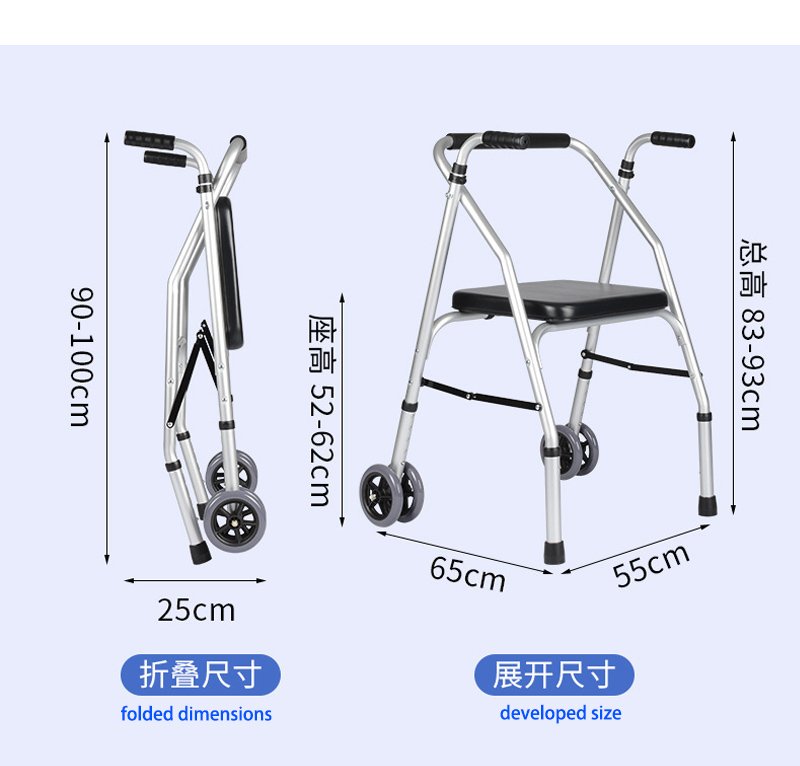
Walkers for elderly users generally fall into several structural groups: standard walkers without wheels, two-wheeled walking frames, three-wheeled rollators, four-wheeled rollators, and specialist designs such as upright and knee walkers. Each solves a different mobility problem. A standard frame offers a stationary support base but must be lifted. A two-wheel walker reduces lifting. Rollators allow continuous movement and often include a seat, while specialist models address more specific support or rehabilitation needs. For distributors, the right range depends on user capability, care setting, frame design, and the level of support the product is expected to provide.
When buyers ask which type of walker is most suitable for older users, I would avoid answering with a single product name. The more useful question is: what does the user need the frame to do? Some users need a stable frame that stays in place while they take a step. Others need to move without repeatedly lifting the equipment. Some need a seat for rest breaks. Those requirements lead to different products, different frame structures, and different purchasing priorities.
1. What are the main types of walkers available to buyers?
The walker market is often divided by the number and position of wheels, but that classification alone does not tell the whole story. A product’s support method, braking system, frame geometry, and intended environment are just as important. The following categories provide a practical starting point for building a product range.
Standard walker without wheels
A standard walker has four legs and no wheels. The user lifts the frame, places it slightly ahead, and then steps forward. Rubber tips or non-slip feet contact the floor at all four points. This design is often selected when a user needs a stationary support structure and can manage the lifting movement.
For distributors, the main selling points are straightforward construction, low product weight, and a relatively simple maintenance profile. There are no wheel bearings or hand-brake cables to adjust. However, the user must have enough upper-body strength and coordination to lift and reposition the frame safely. A standard walker may also slow down walking because the user has to complete a lift-and-place sequence with each movement.
Dinglian’s DL-7011 is listed on the company’s website as an aluminum alloy folding walker, with a net weight of 2.25 kg and a stated load-bearing capacity of 150 kg. Its folding size is 54 × 10 × 75 cm, and its product dimensions are 55 × 49–53 × 73–91 cm. These specifications make it a relevant example of a conventional folding walking frame rather than a wheeled rollator.
Two-wheeled walker
A two-wheeled walker usually has wheels at the front and non-wheeled contact points or glides at the rear. The user can move the frame forward without lifting the entire structure every time. The rear contact points help resist uncontrolled movement, although the product still needs to be used with the correct walking technique.
This design is often considered when a standard walker is too demanding to lift but a four-wheel rollator is not appropriate for the user’s support needs. It occupies a useful middle position: easier forward movement than a fixed-leg frame, with more resistance to rolling than a four-wheel design.
Dinglian lists the DL-7012 as a rolling walker made from aluminum alloy. Its published specifications include a net weight of 3.35 kg, a 150 kg load-bearing capacity, adjustable product height of 75–85 cm, and front and rear wheel sizes of 2.5 inches and 3 inches respectively. For a buyer, the different wheel sizes are worth checking against the intended floor conditions and the product’s turning behavior.
Three-wheeled rollator
A three-wheeled rollator generally uses a triangular frame with one front wheel and two rear wheels. It is designed around maneuverability. Compared with many four-wheel designs, the narrower front structure can make it easier to turn through tight indoor areas and navigate around furniture.
The trade-off is that a three-wheel design typically does not provide the same seating arrangement found on many four-wheel rollators. It may also feel less reassuring to users who expect a broad support footprint. The buyer should therefore look beyond the compact folded shape and assess steering response, brake access, frame rigidity, and how the product behaves during turns.
Three-wheel rollators are a recognized market category, but they should not be confused with a two-wheel walking frame. The latter normally uses rear glides or non-wheeled feet, while a three-wheel rollator has wheels at all three contact points and relies on its hand-brake system to control movement.
Four-wheeled rollator
A four-wheel rollator has wheels at all four corners, hand-operated brakes, and often a seat and storage bag or basket. It allows the user to keep the frame moving rather than lifting it with each step. The seat can also provide a place to rest when the user becomes tired, provided the brakes are correctly engaged before sitting.
This category is commercially broad. A compact model for indoor use, a lightweight aluminum model for transport, and a larger model with a different seat height may all be sold as four-wheel rollators. They should not be treated as interchangeable simply because they share the same basic wheel count.
Dinglian’s website lists several four-wheel rollator models, including the DL-7071T, DL-7077D, and DL-7078C. Their published dimensions, frame materials, weights, and seat heights differ. That gives distributors room to select products for different customer requirements instead of relying on one specification for every channel.
Specialist walker designs
Some products are designed for needs that a conventional walking frame or rollator does not address directly:
- Upright or forearm-support walker: Uses padded forearm platforms or supports to change the user’s contact position with the frame. It requires careful attention to support height, frame width, and stability.
- Knee walker: Uses a padded platform to support one knee while the user propels the device with the other leg. It is generally associated with temporary foot or ankle mobility limitations rather than routine balance assistance.
- Posterior or reverse walker: Positions the frame behind the user rather than in front. It is a specialist configuration and should be assessed according to the user’s clinical and rehabilitation requirements.
- U-shaped or enclosed-frame walker: Uses a different frame layout from a conventional open-front walking frame. Buyers should inspect entry access, frame dimensions, and how the user is positioned within the structure.
These specialist categories may be relevant to rehabilitation providers or focused medical channels. However, they should not automatically be added to a general elderly-care product range without evidence of local demand, appropriate product training, and a clear understanding of the intended user group.
2. How do the walker types differ in practical use?
A product comparison becomes more useful when it connects design to the way the equipment is used. The table below compares the main categories from a sourcing and distribution perspective. It is not a clinical prescription chart; individual users should be assessed by an appropriate healthcare professional.
| Walker Type | Contact with Floor | Movement Method | Typical Product Advantage | Main Buyer Check |
|---|---|---|---|---|
| Standard walker | Four non-wheeled feet | Lift and reposition | Stationary support points and simple construction | Frame rigidity, foot tips, folding lock |
| Two-wheel walker | Two front wheels, two rear contact points | Push forward with rear friction | Less lifting than a standard frame | Wheel and glide alignment, height adjustment |
| Three-wheel rollator | Three wheels | Continuous rolling with hand brakes | Compact steering and turning | Turning response, brake performance, frame balance |
| Four-wheel rollator | Four wheels | Continuous rolling with hand brakes | Mobility, optional seat and storage | Brake locking, wheel alignment, seat dimensions |
| Upright walker | Usually two or four wheels, depending on design | Push using forearm support and handles | Alternative upper-limb support position | Armrest adjustment, width, structural stability |
One important distinction often gets lost in online comparisons: a four-wheel rollator is designed for rolling mobility, not for users who need to place substantial body weight onto a stationary frame. The wheels can move when the brakes are not properly engaged. A standard walker or two-wheel frame may be more appropriate in situations where resistance to forward rolling is an important part of the support requirement. Final selection should be made with suitable clinical guidance.
3. Which frame design fits different care environments?
The same walker can perform differently depending on the building layout, floor surface, and daily routine. This is where distributors can add value. Instead of asking customers to choose from a list of features, ask where the equipment will be used and what movement restrictions exist in that environment.
Homes and narrow indoor spaces
In homes, door openings, bathroom entrances, furniture spacing, and storage locations can determine whether a product is practical. A standard walker has no rolling wheels and may suit short indoor routes where the user can lift and reposition it. A compact two-wheel frame can reduce the lifting effort, while a three-wheel rollator may appeal where turning space is limited and the user can manage its braking system.
Do not rely on the overall product width alone. The usable turning area also depends on wheel position, handle projection, frame geometry, and the user’s ability to maneuver the device. Ask for the actual product dimensions and, where possible, evaluate a sample in a representative indoor layout.
Care homes and rehabilitation facilities
Institutional buyers often need more than one walker type. Residents may have different mobility levels, and staff may need to move equipment between rooms, storage areas, and treatment spaces. A standard frame can serve one group of users, while two-wheel walkers and rollators may be needed for others.
For care facilities, the cleaning and maintenance routine matters as much as the initial product price. Open frame structures are generally easier to inspect visually. Products with more moving parts, cables, upholstery, or accessories need a clear cleaning and maintenance procedure. The buyer should ask how replacement parts are supplied and whether the supplier can maintain consistent specifications across repeat orders.
Outdoor routes and longer walking distances
For outdoor use, wheel diameter, tire material, frame weight, brake control, and folding dimensions deserve attention. Small wheels may be convenient indoors but can be less forgiving over uneven surfaces, thresholds, or rough paving. Larger wheels may improve obstacle handling, but they can also affect total product weight, packaging volume, and cost.
A four-wheel rollator with a seat may be relevant when rest breaks are part of the intended use. However, the seat does not make the product suitable for every user. The frame must be stable when stationary, the parking brakes must work correctly, and the seat dimensions must match the intended market requirements.
4. What should buyers check when comparing walker materials and construction?
Material selection affects product weight, corrosion resistance, frame stiffness, production cost, and the final selling price. But a material name by itself does not establish product quality. An aluminum walker with poorly designed joints can perform worse than a well-made steel model. Buyers should compare the complete structure rather than choosing a product simply because its specification says aluminum alloy or steel.
Aluminum alloy frames
Aluminum alloy is widely used in folding walkers and rollators because it can reduce finished product weight and offers useful corrosion resistance. It is often considered for products that need to be carried, folded, loaded into vehicles, or moved frequently by caregivers.
For procurement, ask the supplier to confirm the alloy specification where relevant, tube dimensions, wall thickness, and the construction method used at joints. The final weight should be checked against the complete assembled product, not estimated from the frame material alone. Wheels, seat assemblies, baskets, brakes, and accessories all contribute to finished weight.
Steel frames
Steel can be suitable where buyers prioritize a particular balance of rigidity, cost, and frame configuration. It is commonly used in mobility equipment where the design requires formed tubes, welded connections, and a durable surface finish. The trade-off is that a steel product may be heavier than a comparable aluminum design, depending on the structure.
A steel frame should be evaluated for weld consistency, surface preparation, coating coverage, and protection around joints and edges. If the coating is damaged during production, packaging, or transport, exposed areas may become vulnerable to corrosion. A good-looking finish on one sample is not enough; buyers should ask how coating quality is controlled across production batches.
Folding joints, adjustment holes, and locking parts
These components deserve close inspection because they are operated repeatedly. A walker may be folded for storage every day. Height-adjustment buttons may be pressed whenever the equipment is shared or reassigned. If a locking pin does not engage fully, or a folding joint develops excessive play, the user may notice movement that was not present in the approved sample.
During supplier evaluation, inspect the following points:
- Tube cutting and hole positioning should be consistent.
- Bending should not create visible deformation or uneven alignment.
- Welded areas should be consistent and free from obvious defects.
- Folding locks and adjustment pins should engage and release reliably.
- Coating should cover the frame evenly, including areas around joints.
- Wheels, glides, and rubber feet should sit correctly and contact the floor as intended.
A manufacturer with a controlled process should be able to explain how these details are checked, how nonconforming parts are handled, and how the approved sample is kept consistent with mass production. These questions are more useful than asking whether a factory has “strict quality control” without requesting any process detail.
5. How should distributors compare actual models instead of relying on category names?
Category names are useful for organizing a catalog, but they are not enough for purchasing decisions. Two products both described as walkers may differ significantly in frame weight, load capacity, height range, folding size, and intended use. A model-level comparison helps buyers identify where each product belongs in their range.
The following examples are based on the specifications currently published on Dinglian’s website. They illustrate several different configurations within the company’s walking-aid portfolio. They should not be read as a direct clinical comparison because the models do not all belong to the same structural category.
| Model | Product Type | Frame Material | Published Weight / Capacity | Buyer Consideration |
|---|---|---|---|---|
| DL-7011 | Folding walking frame | Aluminum alloy | 2.25 kg net / 150 kg capacity | Lightweight frame with no-wheel configuration |
| DL-7012 | Rolling walker | Aluminum alloy | 3.35 kg net / 150 kg capacity | Front and rear wheel sizes differ; check floor suitability |
| DL-7071T | Four-wheel rollator | High-carbon steel | 8.25 kg net / 150 kg capacity | Seat, folding size, and steel-frame positioning |
| DL-7077D | Four-wheel rollator | Aluminum alloy | 7 kg net / 150 kg capacity | Seat height 47–56.5 cm; 6-inch wheels |
| DL-7078C | Four-wheel rollator | Aluminum alloy | 7.2 kg net / 150 kg capacity | Seat height 57 cm; 6-inch wheels |
The comparison shows why a distributor should not select a model by material or weight alone. The DL-7011 and DL-7012 serve different movement formats even though both use aluminum alloy. The DL-7071T, DL-7077D, and DL-7078C are all four-wheel rollators, but their frame materials, weights, seat heights, and dimensions create different product positions.
Before issuing a purchase order, confirm the complete specification on the current product page and the final approved quotation. If a market requires a specific seat height, folded dimension, carton size, wheel diameter, or load rating, put that requirement into the purchase specification rather than relying on a general product description.
6. What quality checks matter most before mass production?
For a small sample order, buyers can often inspect each unit closely. For a larger order, the challenge is different: the factory must reproduce the same dimensions, assembly quality, braking performance, and finish across the batch. This is where manufacturing controls become commercially important.
Incoming material and frame processing
The inspection process should begin before assembly. Tube material and dimensions need to match the approved specification. Cutting and drilling positions affect how parts fit together. Bending accuracy affects frame alignment. For welded structures, joint quality and consistency should be checked before surface treatment makes the area harder to inspect.
Assembly and functional checks
At assembly stage, the buyer should pay attention to wheel alignment, brake response, folding locks, height-adjustment mechanisms, handle installation, and seat attachment where applicable. A product can meet its stated dimensions but still feel inconsistent if the wheels track unevenly or the brake levers require noticeably different force from one unit to another.
Packaging and shipment readiness
Packaging is part of product quality for export orders. Folded dimensions, carton size, protective materials, and accessory placement affect freight efficiency and the condition of goods on arrival. A compact folding walker may have a very different carton profile from a four-wheel rollator with a seat and larger wheels. Buyers should check whether the packaging protects exposed frame surfaces and prevents loose parts from rubbing against the product during transport.
If the buyer needs private-label packaging, barcode labels, manuals, or market-specific documentation, these should be agreed before production begins. Late changes can create rework, delay shipment, or lead to inconsistent packaging across cartons.
7. How can a distributor build a balanced walker product range?
A distributor does not need every walker type in every market. A better starting point is to identify the customer groups already served and the product gaps that appear repeatedly in inquiries. A general medical supply wholesaler may need a dependable standard frame and a small selection of rollators. A rehabilitation-focused distributor may require more specialist configurations. A care-home supplier may put greater emphasis on ease of cleaning, repeat availability, and replacement parts.
A practical product range could be organized around these purchasing roles:
- Entry-level walking support: Standard folding frames for customers who need a simple, non-wheeled structure.
- Assisted forward movement: Two-wheel walkers for channels that need an option between a fixed frame and a rollator.
- Everyday rolling mobility: Four-wheel rollators in different weights, seat heights, wheel sizes, and frame materials.
- Specialist rehabilitation: Upright, knee, or other specialist walkers only where local demand and product training justify the inventory.
This approach reduces unnecessary overlap. If two models have almost identical dimensions, weight, and user positioning, the distributor should have a clear reason to stock both. Differences in frame material, seat height, wheel configuration, or packaging may justify separate models, but cosmetic color changes alone may not create enough commercial distinction for every market.
Dinglian’s Rollator Walker range can be reviewed alongside the wider Our Equipment portfolio when planning a mobility-aid assortment. This helps buyers compare rollators with other rehabilitation and elderly-care products rather than evaluating each item in isolation.
8. What should buyers ask a walker manufacturer before ordering?
A supplier’s product photographs and headline specifications are only the beginning of an evaluation. A professional buyer should ask questions that reveal whether the supplier can deliver the required configuration repeatedly.
- Can the supplier provide a complete specification sheet with product, folded, and carton dimensions?
- Are the frame material, tube dimensions, and surface treatment clearly defined?
- What functional checks are performed on brakes, folding locks, adjustment points, and wheels?
- Can the approved sample be retained as the reference for mass production?
- What spare parts are available, and how are replacement orders handled?
- Can packaging, labels, manuals, and product colors be agreed before production?
- What inspection and documentation can be provided for the destination market?
When evaluating Zhongshan Dinglian Rehabilitation Equipment Co., Ltd. as a walker manufacturer, buyers should assess the actual model specifications, sample quality, production arrangements, and communication around order requirements. A reliable factory relationship is built on clear specifications and repeatable execution, not on a broad claim that every product is suitable for every user.
You can learn more about Dinglian’s company background and discuss product configuration, order quantities, packaging, and market requirements through the Contact Us page.
Conclusion: choose the frame according to the support task
The different types of walkers for elderly people are not simply variations in appearance. A standard walker provides a fixed four-point contact structure but must be lifted. A two-wheel walker reduces that lifting action while retaining rear contact points. Three-wheel rollators focus on compact maneuverability, while four-wheel rollators provide continuous rolling movement and often include a seat. Upright, knee, and other specialist walkers address more specific support requirements.
For distributors and procurement teams, the strongest product range is not necessarily the one with the most models. It is the one in which each model has a clear purpose, the specifications match the intended channel, and the supplier can maintain consistent quality from sample approval through mass production.
Start with the user’s support requirement and the environment. Then compare frame design, material, dimensions, adjustment, braking, folding, packaging, and after-sales support. That sequence gives buyers a more reliable basis for selecting walkers and building a product range that can serve real market demand.