
Walking Frame Guide for Medical & Rehab Equipment Buyers
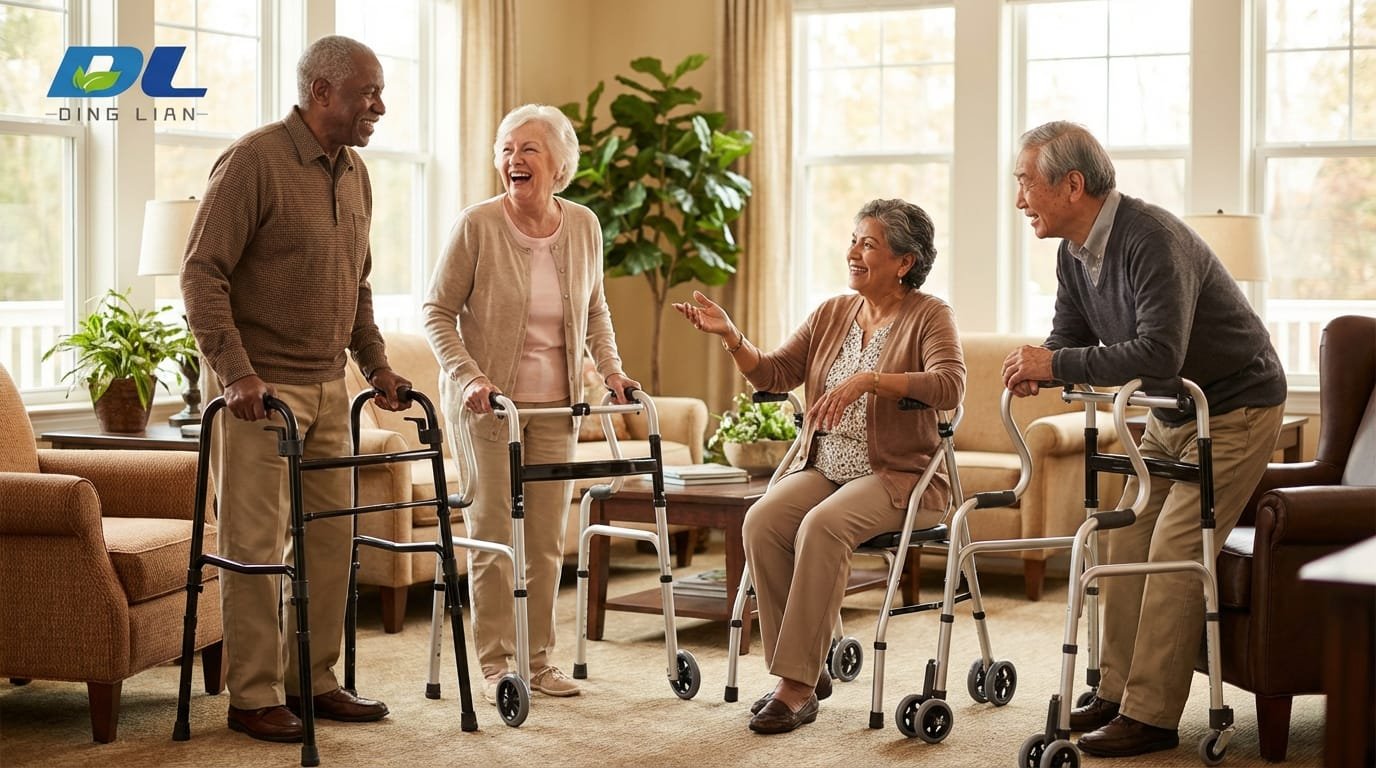
Walking Frame vs Rollator Walker: A Procurement-Focused Guide for Rehabilitation Equipment Buyers
Is a walking frame still necessary in a market increasingly dominated by rollator walkers?
For professional buyers in the rehabilitation equipment sector, this is not a theoretical question. It directly affects patient safety, institutional liability, return rates, and long-term procurement stability.
This guide is written from a buyer and compliance perspective, drawing on real-world sourcing practices, regulatory frameworks, and long-term usage feedback across healthcare and home-care channels.
What Is a Walking Frame in Professional Procurement Terms?
In procurement contexts, a walking frame (also known as a zimmer frame or mobility walker) is not viewed as a lifestyle product. It is a risk-management mobility aid designed to maximize stability for users with limited balance, reduced lower-limb strength, or early-stage rehabilitation needs.
Walking frames remain a core category in:
- Hospitals and rehabilitation centers
- Nursing homes and assisted living facilities
- Home-care programs supported by insurers or public healthcare systems
- Institutional and tender-based procurement projects
From a buyer’s standpoint, the continued relevance of walking frames is driven by one priority: controlled, predictable user behavior.
Walking Frame vs Rollator Walker: Why Buyers Do Not Treat Them as Substitutes
One of the most common sourcing mistakes is assuming that rollator walkers can replace standard walking frames across all care scenarios. In practice, professional buyers treat these products as tools for different risk profiles.
| Procurement Factor | Walking Frame | Rollator Walker |
|---|---|---|
| User Stability | Very high, four-point contact | Moderate, wheel-dependent |
| User Learning Requirement | Minimal | Brake operation required |
| Early Rehab Risk | Lower fall probability | Higher if brakes misused |
| Typical Procurement Channel | Hospitals, nursing facilities | Home-care, retail, community use |
Buyer insight:
Walking frames are selected to minimize variability in user behavior. Rollators are selected to maximize independence once user capability is confirmed.
Why Walking Frames Remain Preferred in Institutional Procurement
Lower Operational Risk and Fewer Returns
Institutional buyers consistently report lower complaint and return rates for standard walking frames compared to wheeled walkers. The primary reason is structural simplicity.
Fewer moving parts result in:
- Reduced misuse scenarios
- Lower maintenance requirements
- More predictable performance across different user profiles
Alignment with Regulatory and Quality Frameworks
For professional buyers, compliance begins with market access rather than individual test methods.
In regulated markets, walking frames are typically evaluated through CE marking, supported by a manufacturer’s quality management system certified under :ISO 13485. These frameworks ensure traceability, risk control, and consistency across production batches.
Technical standards governing stability, static load, and fatigue performance are generally applied as internal engineering references, supporting—not replacing—formal compliance systems.
Predictable Lifecycle Cost
Walking frames offer procurement stability over time:
- Longer usable service life
- Minimal spare-part dependency
- Lower after-sales support burden
For buyers managing public healthcare or long-term care contracts, lifecycle predictability often outweighs initial unit price.
Key Engineering and Selection Factors Buyers Evaluate
Stability-to-Weight Balance
While lightweight designs are attractive in marketing, professional buyers focus on stability first. Excessive weight reduction can compromise lateral rigidity and long-term safety.
Experienced procurement teams assess:
- Aluminum tubing wall thickness
- Joint reinforcement design
- Anti-slip ferrule performance on wet surfaces
Adjustability and Population Coverage
Height-adjustable walking frames reduce SKU complexity and improve population coverage. However, buyers also evaluate long-term durability of adjustment mechanisms, especially pin-lock systems exposed to repeated use.
Folding Mechanism: Logistics Efficiency vs Structural Reliability
From a procurement perspective, folding walking frames are primarily selected for logistics efficiency rather than user comfort.
- Container optimization – Higher loading density reduces landed cost per unit.
- E-commerce compatibility – Flat-pack designs simplify warehousing and delivery.
- Retail efficiency – Compact packaging improves shelf utilization.
At the same time, buyers recognize that folding joints are structural stress points. Repeated folding cycles, uneven load distribution, and lateral movement introduce fatigue risks that are not visible in short-term sample inspections.
As a result, professional buyers evaluate folding models within a broader walking frame portfolio, prioritizing long-term reliability supported by documented quality systems rather than appearance-based assessments.
Regional Procurement Considerations Buyers Should Anticipate
Europe
Procurement emphasizes CE compliance, documentation completeness, and consistency across production batches. Walking frames are frequently specified by clinicians rather than end-users.
North America
Demand leans toward adjustable and foldable designs, driven by home-care distribution. Buyers still expect institutional-grade durability.
Emerging Markets
Walking frames often represent the first stage of mobility aid adoption. Stability and durability outweigh advanced features.
Common Procurement Errors to Avoid
- Over-prioritizing unit price without lifecycle cost analysis
- Relying solely on demo samples for folding designs
- Confusing internal test standards with market compliance requirements
- Applying rollator selection logic to early-stage rehabilitation users
Final Procurement Insight
Walking frames continue to play a foundational role in rehabilitation care—not because they are simple, but because they are predictable.
For distributors and institutional buyers, selecting the right walking frame means aligning safety, compliance, and long-term reliability. When evaluated through a procurement and compliance lens, walking frames remain one of the most stable categories in rehabilitation equipment sourcing.
For buyers seeking deeper technical or compliance clarification, engaging directly with the manufacturer remains the most efficient next step. You may contact the manufacturer directly to discuss documentation, testing scope, and long-term supply suitability.