
How Is Rollator Walker Frame Strength Tested?
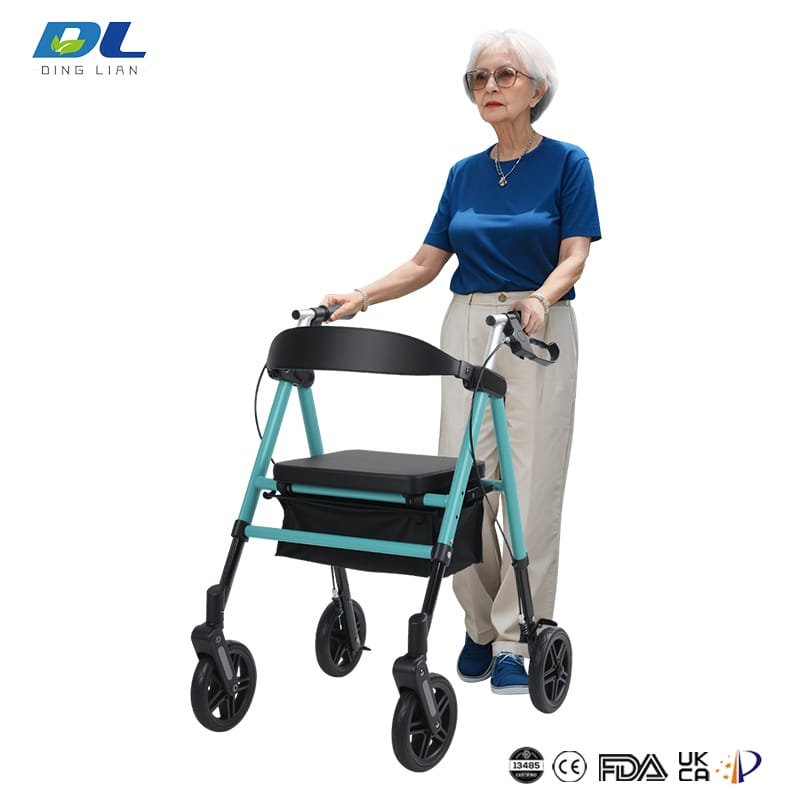
What Actually Determines the Strength of a Rollator Walker?
A rollator walker frame is tested through controlled static loading, repeated fatigue loading, and inspections of its structural connections. These tests help determine whether the frame can withstand concentrated forces and repeated movement without cracking, breaking, or developing unacceptable permanent deformation. For professional buyers, however, a single load-bearing figure is not enough. Material thickness, tube geometry, welding quality, folding joints, fasteners, and locking mechanisms all influence long-term performance. A walker rated for 150 kg still needs appropriate structural verification before that figure can be treated as reliable purchasing information.
When sourcing mobility equipment, I would start with a simple question: what happens to the frame after the product has been used thousands of times, rather than just once? That distinction separates a product that survives a demonstration from one that is suitable for regular distribution through medical equipment channels.
The frame is the main load-carrying structure, but it does not work independently. Forces travel from the handgrips through the upper tubes, joints, crossbars, lower supports, and wheels. If one connection is poorly designed, the overall structure can become the weak point even when the main steel tubes are relatively strong.
Which International Standard Is Used to Assess Rollator Frame Strength?
One important reference for manufacturers and professional buyers is ISO 11199-2:2021, which covers requirements and test methods for rollators operated with both arms. It addresses everyday use, safety, ergonomics, performance, materials, structural strength, stability, and durability.
The standard includes several separate structural assessments rather than relying on one general load test. These include static strength of the rollator, strength of the resting seat, backrest strength, and a durability test. Each addresses a different potential failure point.
There is also an important standards update that procurement teams should understand. ISO published Amendment 1:2024, which removes the brake requirements from ISO 11199-2:2021. This means buyers should check which edition and amendment are referenced in a supplier’s test documentation instead of assuming that an older report automatically reflects the current standard.
For the official scope and publication information, consult the ISO 11199-2:2021 standard and its 2024 Amendment 1.
Why does the standard matter to distributors?
It gives buyers a common technical reference when comparing products from different manufacturers. Without a defined test method, one supplier might describe a frame as strong because it supports a heavy load for a few minutes, while another may have conducted repeated loading tests under controlled conditions.
Those are not equivalent claims.
When reviewing a supplier’s documents, check the following:
- Whether the report identifies ISO 11199-2:2021 and the applicable amendment.
- Whether the tested product matches the model being quoted.
- Whether the maximum user mass is clearly stated.
- Whether the test configuration matches the actual product design.
- Whether the report records the results and any structural abnormalities.
How Does Material Selection Affect Frame Strength?
Material selection is the first structural decision, but it should never be judged by material name alone. Steel and aluminum alloy are both used in rollator manufacturing. Their performance depends on the selected grade, tube dimensions, wall thickness, forming process, joining method, and final frame geometry.
Steel frames: strength and structural rigidity
Steel is commonly selected for rollators designed around a relatively rigid frame and a competitive manufacturing cost. High-carbon steel tubing can provide a practical balance of stiffness, strength, and production efficiency when the tube dimensions and fabrication process are properly controlled.
However, a thicker steel tube does not automatically produce a better walker. Excessive material can increase the product’s weight, make handling less convenient, and increase shipping costs. Poorly positioned welds or badly designed joints can also weaken a structure regardless of tube thickness.
For steel models, buyers should pay attention to:
- Tube diameter and wall thickness consistency.
- Tube bending accuracy and deformation around corners.
- Weld penetration and continuity at structural joints.
- Corrosion protection and coating coverage.
- Dimensional consistency between production batches.
Aluminum alloy frames: reducing weight without ignoring rigidity
Aluminum alloy is often chosen when product weight and portability are important selling points. It can reduce the effort required to lift, fold, and transport a rollator. This makes it attractive for distributors serving home-care, rehabilitation, and retail mobility markets.
Nevertheless, lightweight construction requires careful engineering. Aluminum and steel have different mechanical properties, so replacing a steel tube with an aluminum tube of identical dimensions does not guarantee equivalent performance.
Designers may need to adjust the tube profile, wall thickness, joint structure, and reinforcement points to achieve the required stiffness. Welding parameters also matter because heat can affect the properties of certain aluminum alloys in the heat-affected zone.
Material and construction comparison
| Evaluation factor | High-carbon steel | Aluminum alloy | Production concern | Buyer consideration |
|---|---|---|---|---|
| Frame weight | Generally heavier | Generally lighter | Material selection and tube dimensions | Handling and freight cost |
| Structural rigidity | Good potential with suitable design | Depends on alloy and section geometry | Tube profile and reinforcement | Resistance to frame deformation |
| Joining process | MIG or other suitable welding processes | Requires alloy-appropriate welding control | Heat input and joint consistency | Inspect weld quality and repeatability |
| Corrosion protection | Surface coating is important | Natural oxide layer and additional finishes | Surface preparation and finishing | Resistance to expected environments |
| Cost structure | Often economical for standard designs | Material and processing costs vary | Material price and fabrication efficiency | Total landed cost and target market |
For procurement purposes, I would not rank one material as universally superior. A steel rollator may be a better commercial choice for a market that prioritizes structural rigidity and price. An aluminum model may be more appropriate where lower product weight is a purchasing priority. The correct decision depends on the intended customer, product configuration, and verified performance.
How Is Static Frame Strength Tested?
Static strength testing checks how a rollator responds to a gradually applied load held for a defined period. Unlike a brief hand-pressure demonstration, a controlled test applies force at a specified position and measures whether the frame suffers damage or permanent deformation.
Under Section 16.2 of ISO 11199-2:2021, the rollator is tested in its most adverse configuration. The loading force is applied vertically through the specified reference position between the rear handgrip reference points.
The loading procedure
- Inspect the sample: Check the frame, adjustment components, joints, and locking mechanisms before loading.
- Record the original height: Measure the rollator height with an accuracy of ±2 mm.
- Position the loading equipment: Apply the force vertically at the specified handgrip reference position.
- Increase the force gradually: Reach the target load over at least two seconds.
- Maintain the load: Keep the maximum force applied for at least one minute.
- Inspect and measure again: Record any cracking, breakage, or permanent reduction in frame height.
For a rollator specified for a maximum user mass of 100 kg, the standard specifies a static loading force of 1,200 N ±24 N. For other rated user masses, the force is calculated at 12 N per kilogram, with a minimum specified load of 420 N ±8.4 N.
The acceptance requirement is equally important: no part of the rollator shall crack or break, and permanent deformation of the rollator height shall not exceed 1%.
What does this test reveal?
Static loading can expose weak crossbars, inadequate tube dimensions, poor joint design, and structural problems around the upper frame. It also helps determine whether the product returns to an acceptable dimensional condition after the load is removed.
However, passing this test does not prove that the product will remain reliable over months or years. A frame can tolerate one controlled loading event and still develop fatigue damage under repeated daily use.
Why Is Fatigue Testing More Important Than a Single Load Test?
This is where I would spend more time when evaluating a new rollator supplier. A product may pass a static loading test but still develop problems after repeated use. Every time a user pushes down on the handles, crosses an uneven surface, turns a wheel, or folds the frame, different parts of the structure experience changing forces.
Repeated stress can gradually affect welded joints, tube connections, adjustment holes, folding mechanisms, and locking components. These problems may not be visible during a short factory demonstration.
Fatigue testing addresses this issue by applying repeated loading to simulate the mechanical demands associated with everyday use.
How does the durability test work?
ISO 11199-2:2021 specifies a durability test using either double-drum equipment or a running-belt arrangement. The rollator is positioned so that its wheels interact with the moving test surface while a controlled vertical force is repeatedly applied to the frame.
For a rollator with a maximum user mass of 100 kg, the specified cyclic force is 800 N ±16 N. For other declared user masses, the force is calculated at 8 N per kilogram, with a minimum loading force of 280 N ±5.6 N.
The test also controls the loading frequency, which must not exceed 1 Hz. The specified number of loading cycles is 200,000.
This is a particularly useful distinction for buyers: fatigue testing is not simply about applying more weight. It examines how a structure behaves when the load is repeated over an extended test sequence.
What should happen after 200,000 cycles?
The standard requires that no part of the rollator cracks or breaks and that all adjustments and locking devices continue to work as intended.
For procurement teams, I would look beyond the final pass result and ask whether the report records the condition of the following components:
- Main frame tubes and crossbars.
- Welded intersections and reinforcement areas.
- Folding pivots and connecting brackets.
- Height-adjustment holes and locking pins.
- Handle supports and wheel mounting connections.
- Any components that show looseness or abnormal movement after testing.
Which Frame Components Are Most Likely to Become Weak Points?
When inspecting a rollator, I would not spend all my attention on the largest frame tubes. In many cases, the more important areas are where separate components meet or where the structure changes direction.
1. Welded joints
Welding connects major structural sections, so inconsistent weld quality can affect the entire frame. Common concerns include incomplete fusion, uneven weld appearance, excessive spatter, undercutting, and local distortion caused by uncontrolled heat input.
Visual inspection is useful, but it cannot identify every internal welding defect. Where the design and risk assessment justify it, additional inspection methods may be appropriate.
For routine production control, manufacturers should establish consistent welding parameters, fixture positioning, operator procedures, and inspection criteria. Automated or robotic welding can improve repeatability, but automation alone does not guarantee a sound joint. The process still needs correct programming, suitable fixtures, and regular maintenance.
2. Folding mechanisms and locking joints
Folding rollators introduce additional moving connections. These mechanisms need to remain secure when the walker is opened and used, while still allowing the product to fold conveniently for storage and transportation.
Buyers should examine the following:
- Whether the locking pin engages completely.
- Whether the frame has excessive lateral movement when opened.
- Whether the folding joint shows abnormal gaps or misalignment.
- Whether the locking mechanism remains functional after repeated operation.
- Whether fasteners remain secure during handling and use.
A frame can have strong steel tubing and still perform poorly if its folding connections are not properly designed. This is why the locking system should be evaluated as part of the complete structural assembly.
3. Bolts, screws, and mechanical connections
Bolted connections are often used around handles, seat supports, wheel brackets, and adjustable components. Incorrect tightening torque, poor thread engagement, or unsuitable fasteners can lead to looseness during repeated use.
Production inspection should include checking fastener specifications, tightening procedures, and assembly consistency. For adjustable connections, buyers should also check whether repeated adjustment causes excessive wear or loss of locking performance.
4. Tube bending and dimensional accuracy
Tube bending can change the local shape and wall distribution of a metal tube. If the bending radius is unsuitable or the process is poorly controlled, the tube may become flattened, wrinkled, or locally weakened.
Inconsistent frame dimensions can also make assembly difficult. One component may need to be forced into position, creating residual stress before the product has even entered service.
This is why dimensional inspection is not simply an appearance check. It helps determine whether the frame has been manufactured according to its intended geometry.
How Should a Rollator Manufacturer Control Frame Quality During Production?
Laboratory testing verifies product performance under defined conditions. Factory quality control serves a different purpose: it helps ensure that the production units remain consistent with the tested design.
For a distributor ordering several hundred or several thousand units, this distinction is commercially important. A well-tested sample does not automatically mean that every subsequent production batch will have identical welding, dimensions, and assembly quality.
A practical production inspection sequence
| Production stage | Inspection focus | Suitable method | Potential problem | Procurement value |
|---|---|---|---|---|
| Incoming materials | Tube dimensions and material specifications | Measuring tools and material records | Inconsistent material or dimensions | Confirms material consistency |
| Tube processing | Bending shape and dimensional accuracy | Fixtures and dimensional checks | Flattening or misalignment | Reduces assembly variation |
| Welding | Joint appearance and consistency | Visual inspection and suitable additional testing | Weld defects and distortion | Controls connection quality |
| Surface treatment | Coating coverage and surface condition | Visual inspection and coating measurement | Uneven finish or exposed metal | Supports corrosion protection |
| Final assembly | Folding, adjustment, and locking | Functional operation checks | Loose joints or incomplete locking | Confirms assembly consistency |
| Finished product | Dimensions and declared load performance | Measurement and applicable product tests | Performance variation | Supports batch acceptance |
At Zhongshan Dinglian Rehabilitation Equipment Co., Ltd., manufacturing equipment includes robotic welding arms, precision weighing instruments, automated packing systems, and specialized packaging machinery. These facilities support production consistency and handling operations at different manufacturing stages.
However, buyers should distinguish manufacturing equipment from testing equipment. A robotic welding arm supports the welding process; it does not independently prove that the finished rollator has passed static strength or fatigue testing.
You can see the manufacturing facilities and production equipment on our factory equipment page.
How Do Different Rollator Designs Affect Structural Performance?
Not every rollator needs the same structural configuration. A heavier steel model, a lightweight aluminum model, and a compact folding model have different design priorities. Comparing them only by weight or maximum user mass can lead to an incomplete purchasing decision.
Steel rollators for markets prioritizing rigidity and value
A steel frame is a practical option for distributors supplying customers who prioritize a stable walking aid, straightforward maintenance, and competitive pricing.
For example, Dinglian’s DL-7071T uses a high-carbon steel frame. Its published specifications include a net weight of 8.25 kg, a maximum load-bearing capacity of 150 kg, a seat height of 53 cm, and 6-inch wheels.
The model is designed with a folding structure, adjustable handles, and a tool-free installation approach. These features make it relevant to distributors looking for a conventional four-wheel rollator with a seat.
Its 150 kg rating is a declared product specification, not by itself evidence of a particular static or fatigue test result. Buyers should request the corresponding model-specific verification when evaluating compliance.
Aluminum rollators for weight-sensitive product ranges
Aluminum models are worth considering when portability is an important selling point. Dinglian’s DL-7077D, for example, uses an aluminum alloy frame and has a published net weight of 7 kg with a declared load-bearing capacity of 150 kg.
Its seat height is adjustable from 47 to 56.5 cm, and its published product dimensions are 62 × 61 × 80–96 cm.
For distributors, the interesting point is that a lighter product can retain a similar declared load rating to a heavier steel model. Nevertheless, material and weight comparisons do not replace structural verification. The two designs should be assessed using the relevant test evidence for their respective configurations.
| Comparison factor | DL-7071T | DL-7077D | Structural implication | Buyer decision |
|---|---|---|---|---|
| Frame material | High-carbon steel | Aluminum alloy | Different material characteristics | Choose by target market |
| Net weight | 8.25 kg | 7 kg | Different handling requirements | Consider portability |
| Declared load | 150 kg | 150 kg | Same stated capacity | Verify test evidence |
| Seat height | 53 cm | 47–56.5 cm | Different user positioning | Match local demand |
| Wheel size | 6 inches | 6 inches | Same nominal wheel diameter | Evaluate overall configuration |
These two models illustrate why material selection should be considered alongside the complete frame design. Neither steel nor aluminum automatically wins every purchasing comparison. The better product is the one that meets the intended market’s handling, structural, and commercial requirements with appropriate supporting test documentation.
Distributors can review the wider Dinglian rollator walker product range to compare available frame configurations and specifications.
What Should Buyers Request Before Placing a Bulk Rollator Order?
When a new supplier quotes a rollator at an attractive price, it is tempting to focus immediately on the unit cost, MOQ, packaging, and delivery time. Those commercial factors matter, but the quality documentation should be reviewed before the product is approved for a long-term supply arrangement.
I recommend following a practical five-step evaluation process.
Step 1: Confirm the actual product specification
Request the material description, tube dimensions where relevant, declared maximum user mass, product weight, folding structure, and component specifications. Make sure the information matches the exact model in the quotation.
Step 2: Review structural test documentation
Ask whether the supplier has static strength and durability test reports applicable to the model. Check the testing standard, sample identification, test loads, number of cycles, and recorded results.
Step 3: Inspect the physical sample
Check welds, frame alignment, folding joints, adjustment positions, locking engagement, and wheel mounting points. Operate the folding system several times and look for unusual movement or inconsistent engagement.
Step 4: Evaluate batch consistency
Ask how incoming materials, welding, dimensional accuracy, and final assembly are controlled. If you are purchasing under your own brand, agree on the product specification and inspection criteria before mass production begins.
Step 5: Confirm the packaging and shipment requirements
Frame damage can occur during transportation if the product is not adequately protected. Check carton dimensions, internal protection, folding position, packaging weight, and loading arrangements. For larger orders, packaging efficiency can also influence container utilization and landed cost.
Frequently Asked Questions About Rollator Frame Strength Testing
1. Does a 150 kg load-bearing rating mean the rollator has passed a 150 kg frame test?
No. A declared maximum user mass is a product specification. Static strength and durability tests use prescribed forces and loading procedures that are not necessarily identical to the stated user mass. Ask for the relevant test report rather than treating the load rating as proof of testing.
2. How many cycles are used in the ISO rollator durability test?
ISO 11199-2:2021 specifies 200,000 loading cycles for its durability test. The cyclic force is based on the declared maximum user mass, with 800 N ±16 N specified for a 100 kg rating.
3. Is a steel rollator always stronger than an aluminum rollator?
No. Steel and aluminum have different mechanical properties, but overall structural performance also depends on tube geometry, wall thickness, material grade, joining methods, and frame design. The complete product should be evaluated through appropriate testing.
4. What is the difference between static strength and fatigue testing?
Static strength testing applies a specified load for a controlled period to evaluate cracking, breakage, and permanent deformation. Fatigue testing repeatedly applies a cyclic load to examine how the structure and its adjustment and locking components perform under repeated mechanical stress.
5. Should distributors request a test report for every rollator model?
Ideally, yes, they should request evidence applicable to each model. Different materials, frame geometries, folding structures, and load ratings can change the structural performance. If a supplier proposes using one report for several models, ask for technical evidence explaining why the tested configuration represents the other products.
6. Can visual welding inspection replace fatigue testing?
No. Visual inspection can identify surface defects, inconsistent weld appearance, and obvious manufacturing problems. It cannot establish how the complete frame will behave under repeated loading. Both production inspection and appropriate structural testing have separate roles.
7. Does passing 200,000 cycles guarantee a particular product service life?
No. The test provides a controlled durability assessment, not a guaranteed number of years of use. Actual service life depends on user behavior, loading conditions, maintenance, environment, and the condition of individual components.
Choosing a Rollator Supplier Based on More Than a Load Rating
Frame strength should be assessed as a combination of material selection, structural design, manufacturing consistency, and verified product performance. A heavy frame is not necessarily a better frame, and a high load-bearing figure does not tell the whole story.
For distributors and professional buyers, the most useful approach is to compare the actual construction with the supporting test evidence. Pay particular attention to welded connections, folding joints, adjustment mechanisms, and the results of both static and repeated loading assessments.
At Zhongshan Dinglian Rehabilitation Equipment Co., Ltd., we focus on manufacturing rehabilitation and mobility equipment for international wholesale and distribution markets. As a rollator walker manufacturer and factory, we understand that product consistency, practical specifications, and clear communication are important when buyers are building a long-term product range.
You can learn more about Zhongshan Dinglian and our manufacturing background, or contact our team to discuss rollator specifications, OEM requirements, and product sourcing.
For model specifications, sample evaluation, or wholesale enquiries, contact our team to discuss your purchasing requirements.