
Folding vs Non-Folding Walking Frames: What Professional Buyers Often Overlook
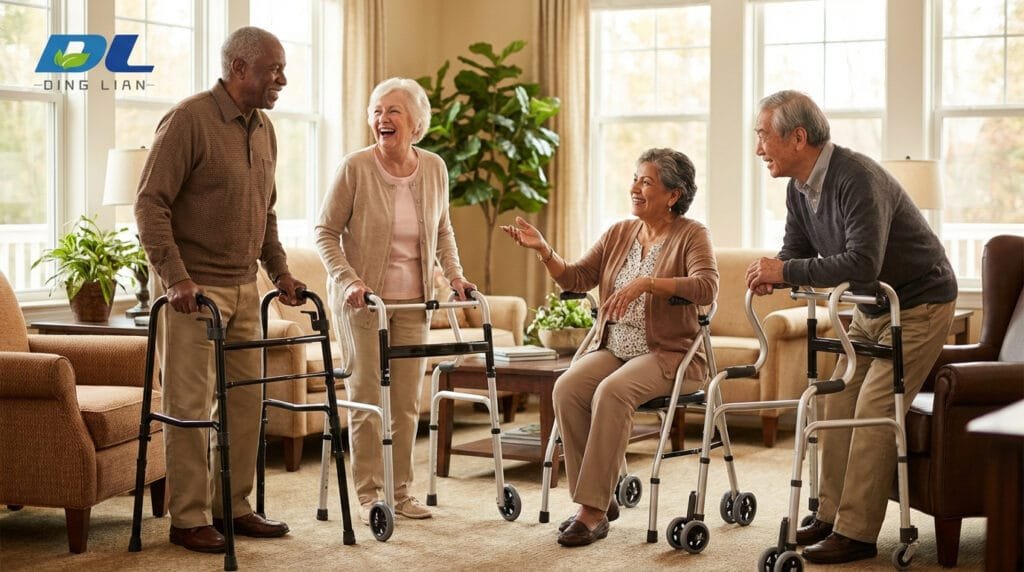
Folding Walking Frame vs Non-Folding: What Buyers Often Overlook
Is a folding walking frame always the better choice? For many buyers, the answer seems obvious—until real-world failures, returns, and compliance audits tell a different story. While folding frames offer clear logistics and retail advantages, non-folding frames still dominate certain institutional and long-term care applications for reasons often underestimated during procurement.
This article examines what professional buyers frequently overlook when comparing folding and non-folding walking frames, drawing from manufacturing data, distributor feedback, and post-market usage insights.
Why Folding Walking Frames Are Popular with Buyers
From a procurement standpoint, folding walking frames are often favored early in the sourcing process due to their apparent commercial advantages.
1. Logistics and Container Efficiency
- Reduced carton volume enables higher container loading density
- Lower freight cost per unit, especially for mixed SKUs
- More flexibility for air freight or e-commerce replenishment
2. Retail and E-Commerce Compatibility
- Slim folded profiles fit standard retail shelving
- Lower dimensional weight for parcel shipping
- Consumer-friendly unboxing experience
3. Consumer Perception
End users often associate foldability with “modern,” “travel-friendly,” or “lightweight” design—an important factor in private-label and homecare channels.
However, these advantages represent only part of the evaluation picture.
What Folding Designs Introduce as Hidden Risks
Folding mechanisms inevitably introduce structural discontinuities. From a buyer’s compliance and liability perspective, this is where deeper evaluation becomes critical.
1. Stress Concentration at Folding Joints
Every hinge, locking pin, or folding rivet becomes a stress point under repeated load cycles. In real-world use, especially among elderly users with uneven gait or higher body weight, these points experience:
- Micro-deformation after prolonged use
- Locking looseness due to wear
- Inconsistent stability on uneven surfaces
Buyers should not rely solely on demo samples. Instead, request:
- Fatigue test reports (not just static load claims)
- Cycle testing data on folding mechanisms
- Failure-mode explanations from the manufacturer
2. Assembly Tolerance Variability
Folding frames involve more components and tighter tolerances. In large-scale production, even small deviations can result in:
- Uneven leg alignment after unfolding
- Locking buttons not fully engaging
- User complaints about “wobbling” despite passing factory QC
This is a frequent cause of after-sales issues in distribution channels.
Why Non-Folding Walking Frames Still Matter
Despite appearing less flexible, non-folding walking frames continue to be specified by hospitals, rehabilitation centers, and long-term care facilities.
1. Structural Integrity and Long-Term Stability
Without folding joints, load paths remain continuous. This results in:
- Higher real-world durability under daily repetitive use
- Lower risk of mechanical loosening over time
- More predictable performance across user weight ranges
2. Institutional Preference
In environments where equipment is shared across users, non-folding frames reduce misuse risks and maintenance complexity. Many tenders explicitly favor simpler structures for this reason.
3. Reduced After-Sales Exposure
From a distributor’s standpoint, fewer moving parts mean fewer failure claims—an often-overlooked cost factor when margins are tight.
Compliance Is More Than a Certificate
Professional buyers often mention CE or ISO certifications, but compliance goes beyond document possession.
For walking frames, responsible manufacturers should be able to demonstrate:
- CE conformity based on applicable walking aid directives
- ISO 13485-certified quality management systems
- Traceable test records linked to specific frame structures
Folding and non-folding frames should not share identical test assumptions. Buyers should verify that structural testing reflects the actual design.
Choosing the Right Structure for Your Market
| Application Scenario | Folding Frame | Non-Folding Frame |
|---|---|---|
| E-commerce / Home use | ✔ Preferred | △ Less common |
| Hospital / Rehab center | △ Limited | ✔ Preferred |
| Travel / Portable use | ✔ Strong fit | ✖ Not suitable |
| Long-term daily use | △ Depends on design | ✔ High stability |
How This Fits into a Complete Walking Frame Strategy
Folding vs non-folding should not be treated as a binary decision. Many experienced buyers manage both structures within a single product line, each clearly positioned for its intended use.
For a broader structural overview of walking frames and buyer evaluation criteria, you can also refer to our in-depth guide: Walking Frame Buyer Guide.
If you are sourcing or developing a walking frame range and need structural, compliance, or market-positioning support, explore our full category here: Walking Frame Product Category.
For project-based discussions or OEM sourcing inquiries, feel free to contact our team directly: Contact Us.
Buyer Takeaway
Folding walking frames offer undeniable logistics and retail advantages—but durability, compliance exposure, and real-world usage patterns deserve equal weight in procurement decisions. Non-folding frames remain essential in professional care settings for good reason.
The most successful buyers are those who match structure to use case—not those who follow market trends blindly.