
Multi-Function Patient Transfer Wheelchairs Explained
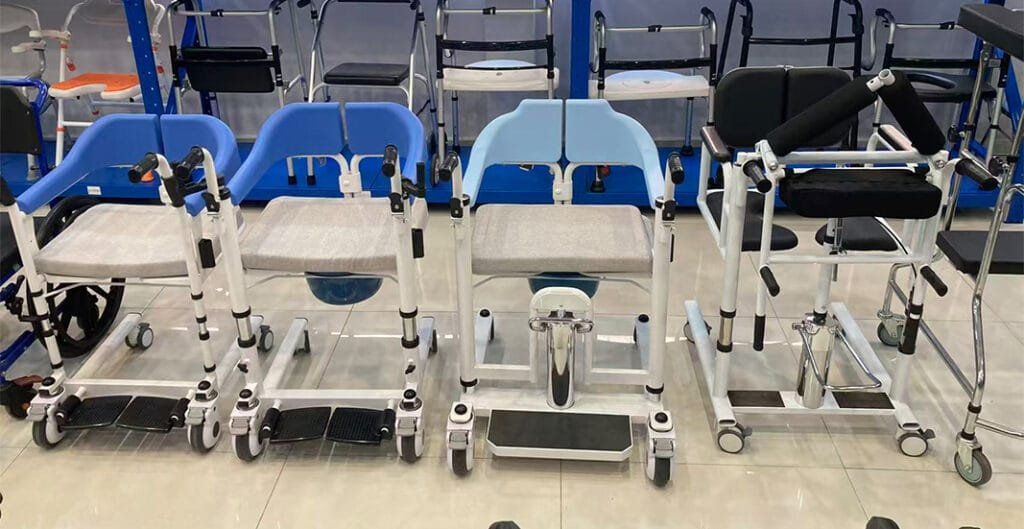
Why Multi-Function Transfer Wheelchairs Are Changing Daily Care Workflows
Many buyers used to treat wheelchairs, commodes, and shower chairs as separate products. In real caregiving environments, that approach creates more problems than it solves. Each transfer between devices increases fall risk, caregiver strain, and time pressure. This is exactly why the patient transfer wheelchair category has evolved into multi-function systems that combine movement, toileting, and hygiene support into one solution. For distributors and procurement teams, understanding how these systems work is now critical for meeting modern care demands.
If you want a full overview of transfer equipment categories and selection logic, start here: Explore the Complete Patient Transfer Equipment Guide →
Industry Insight
Facilities that switch to multi-function transfer systems often reduce daily transfer steps by up to 30–40%, which directly lowers caregiver fatigue and accident rates.
Common Misconception: “More Functions Means More Complexity”
A frequent concern among buyers is that adding more features makes products harder to use. In practice, the opposite is true when the design is done correctly.
Traditional setups require:
- Bed → wheelchair transfer
- Wheelchair → commode transfer
- Commode → shower chair transfer
- Shower → repositioning transfer
Each step introduces risk.
A well-designed transfer commode wheelchair reduces these multiple transitions into one continuous support system.
Buyer Advice
Instead of counting features, experienced buyers focus on how many transfer steps a product can eliminate in daily use.
Why Traditional Equipment Setups No Longer Fit Modern Care Needs
The biggest limitation of traditional equipment is fragmentation.
Caregivers must constantly switch between:
- Wheelchairs
- Commode chairs
- Shower chairs
- Transfer aids
This creates inefficiencies, especially in:
- Home care environments
- Nursing facilities
- Rehabilitation centers
Multi-function mobility transfer chair systems address this by combining these roles into one device.
What Actually Makes a Multi-Function Transfer Wheelchair Effective?
Not all multi-function designs deliver real value. The difference usually comes down to execution.
1. Transfer Accessibility
Open or split-seat designs allow easier positioning without forcing patients into unstable movements.
2. Stable Wheel Locking
Every transfer begins with positioning. Weak brakes are one of the most common failure points in low-cost products.
3. Bathroom Compatibility
Corrosion resistance and compact width are critical for real-world use.
4. Adjustable Height
Matching bed and toilet height reduces lifting strain significantly.
5. Caregiver Operation Efficiency
The system should simplify movement, not add extra steps.
Caregiver Insight
Products that reduce repeated repositioning tasks often create the biggest improvement in caregiver satisfaction, even more than high-end materials or aesthetics.
Where Multi-Function Transfer Wheelchairs Deliver the Most Value
These systems perform best in scenarios where repeated transfers are unavoidable.
- Stroke rehabilitation
- Post-surgery recovery
- Elderly mobility decline
- Long-term home care
- Nursing home environments
In these cases, reducing even one daily transfer step can significantly improve safety and efficiency.
Buyer Comparison: Multi-Function vs Traditional Setup
| Criteria | Traditional Setup | Multi-Function Transfer Wheelchair | Impact on Care |
|---|---|---|---|
| Number of Transfers | Multiple | Reduced | Lower fall risk |
| Caregiver Effort | High | Moderate | Reduced fatigue |
| Bathroom Use | Limited | Integrated | Better usability |
| Space Efficiency | Low | High | Ideal for home care |
| Maintenance | Multiple devices | Single system | Simplified management |
Why Distributors Are Expanding This Category
From a business perspective, multi-function transfer systems solve several common challenges:
- Higher perceived product value
- Lower customer complaint rates
- Stronger repeat purchase demand
- Broader application scenarios
This makes them particularly attractive for distributors targeting elderly-care and rehabilitation markets.
Why Manufacturer Experience Still Matters
Even though many products look similar in catalogs, real-world performance depends heavily on manufacturing quality.
Buyers should pay attention to:
- Frame welding consistency
- Tube thickness
- Caster durability
- Corrosion resistance
- Load-bearing stability
As a rehabilitation equipment manufacturer and factory with long-term export experience, Zhongshan Dinglian focuses on durability and caregiver usability rather than purely visual design.
Learn more about our production capabilities here: About Zhongshan Dinglian →
Future Trend: Integrated Transfer Systems
The market is clearly moving toward integration.
Future products will likely combine:
- Transfer support
- Toilet functionality
- Shower compatibility
- Mobility assistance
- Caregiver-friendly operation
Distributors who adopt these systems early usually gain stronger positioning in rehabilitation and elderly-care segments.
Browse available transfer solutions here: View Patient Transfer Equipment →
Final Thoughts
Multi-function patient transfer wheelchair systems are not just product upgrades. They represent a shift in how daily care is managed.
Reducing transfer steps improves safety, lowers caregiver strain, and simplifies daily routines across different care environments.
For distributors and procurement teams, understanding this shift helps identify products that deliver long-term value rather than short-term cost savings.
If you are sourcing transfer solutions for your market, connect with our team here: Talk With Our Transfer Equipment Team →