
What Should Buyers Check in Rollator Walker Welding Quality?
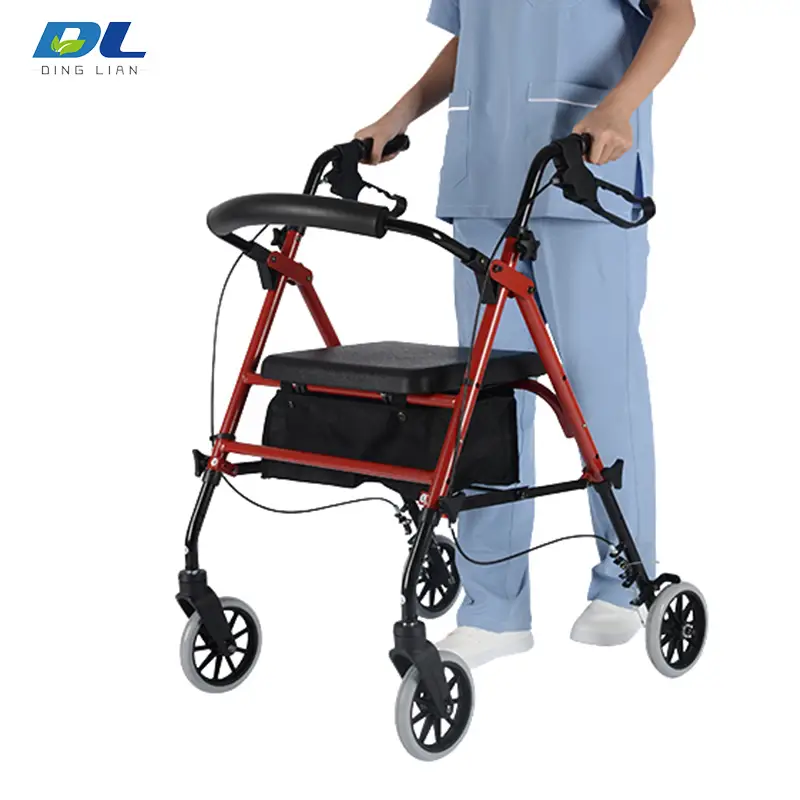
What Does Good Welding Quality Look Like on a Rollator Walker?
Buyers should judge rollator welding quality by more than the appearance of the weld bead. A reliable welded joint should have consistent formation, adequate connection to the parent metal, no unacceptable visible defects, and no excessive distortion around the joint. It should also be positioned correctly within the frame structure. For a distributor inspecting a new supplier, the practical approach is to examine critical joints, compare multiple units from the same batch, and check whether the factory controls welding parameters and inspection records. A smooth-looking weld is a useful first sign, but it is not proof of structural reliability.
I would start with the joints that transfer forces between the main frame tubes, crossbars, handle supports, and wheel mounting structures. These connections have a more direct influence on frame integrity than decorative welds or joints carrying relatively little structural load.
There is a commercial reason to take this seriously. A welding problem discovered before shipment may be corrected at the factory. The same problem discovered after products have reached distributors, hospitals, or rehabilitation equipment dealers can lead to returns, replacement costs, complaints, and questions about the consistency of the entire product range.
When evaluating a rollator walker manufacturer, therefore, I would assess three things together: the finished weld, the way the joint is designed, and the factory process used to reproduce that joint across production batches.
Why Is Weld Appearance Not Enough to Judge Joint Quality?
Weld appearance is the easiest part of an inspection, but it only tells you what can be observed at the surface. A weld may look uniform while having insufficient fusion between the weld metal and the parent material. Conversely, a weld with minor cosmetic irregularities may still satisfy the agreed technical acceptance criteria.
This is why experienced buyers distinguish between appearance, workmanship, and actual joint performance.
Weld bead consistency
Look at the width, height, continuity, and general shape of the weld bead. The bead should be reasonably consistent along the intended welding path. Sudden changes in width, excessive buildup, irregular termination, or sections that appear to have been missed deserve further examination.
However, do not make the mistake of assuming that the widest weld is the strongest. Increasing weld size without considering the joint design can add unnecessary heat, increase distortion, and create an inconsistent finished frame.
Connection to the parent metal
The weld should blend appropriately into the surrounding metal without obvious gaps, incomplete edges, or severe surface irregularities. Pay attention to the weld toes, where the weld meets the base material. Undercut or sharp transitions at these locations can become stress concentration points.
Frame alignment around the welded joint
Inspect the surrounding tubes, not just the weld itself. A joint may have an acceptable appearance but still be positioned incorrectly. Check whether the two connected tubes remain aligned and whether the frame geometry is symmetrical.
For a rollator, this matters because frame misalignment can affect folding, wheel positioning, handle adjustment, and the way forces are distributed during use.
Which Welding Defects Should Buyers Look for?
Not every welding imperfection has the same significance. Some defects are primarily cosmetic, while others can reduce the effective joint area or create local stress concentrations. Buyers should know the common terms so that inspection findings can be communicated clearly to the manufacturer.
1. Porosity
Porosity appears as small cavities or pores in the weld surface. It can result from contamination, moisture, inadequate shielding gas protection, or unstable welding conditions.
Small surface pores may be visible during a close inspection, but internal porosity cannot always be identified through visual examination. The acceptance decision should therefore follow the agreed welding quality criteria rather than an assumption that every small surface mark has the same structural effect.
2. Undercut
Undercut is a groove formed at the edge of the weld where the base metal has been melted away without being adequately filled by weld metal.
This deserves particular attention around frame connections because the weld toe can become a stress concentration location. The concern increases when an undercut is deep, continuous, or located at a highly loaded joint.
3. Incomplete fusion
Incomplete fusion occurs when the weld metal does not properly fuse with the base material or a previous weld pass. It is more serious than a purely cosmetic irregularity because the effective connection may be smaller than intended.
A surface inspection may identify visible signs, but it cannot reliably rule out every internal fusion problem. Where the joint design or risk assessment requires further verification, suitable non-destructive testing or destructive examination of representative samples may be necessary.
4. Cracks
Cracks are a major concern and should not be treated as ordinary cosmetic defects. They can occur in the weld metal or in the heat-affected zone next to the weld.
For a structural rollator joint, visible cracking should trigger rejection and investigation rather than simple surface grinding or repainting. The factory needs to identify the cause and determine whether other products from the same production batch may be affected.
5. Excessive spatter
Spatter consists of small droplets of molten metal deposited around the weld. Some welding processes naturally produce more spatter than others, but excessive or poorly removed spatter can indicate unstable process conditions.
On a finished rollator, sharp protrusions may also affect handling, surface finishing, and coating quality. Spatter should not be confused with a structural crack, but it should still be covered by the factory’s workmanship requirements.
6. Excessive weld buildup or poor termination
Too much weld metal can create an uneven profile, interfere with nearby components, or require unnecessary grinding. Poor starts and stops can leave craters, irregular transitions, or local discontinuities.
For joints near folding brackets, seat supports, and adjustment components, these issues can also create assembly interference.
Common weld imperfections and buyer responses
| Observed condition | Possible cause | Potential concern | Buyer inspection | Recommended response |
|---|---|---|---|---|
| Surface porosity | Contamination or shielding problems | Possible weld discontinuity | Inspect bead surface closely | Check acceptance limits and process records |
| Undercut | Excessive heat or unsuitable travel speed | Stress concentration at weld toe | Inspect both weld edges | Evaluate against agreed criteria |
| Incomplete fusion | Incorrect parameters or joint preparation | Reduced effective connection | Visual check plus suitable further testing | Investigate and verify the joint |
| Cracking | Material, thermal, or process-related problems | Potential structural failure | Inspect weld and adjacent material | Reject and investigate the cause |
| Excessive spatter | Unstable arc or unsuitable parameters | Finishing and handling issues | Check surrounding surfaces | Improve process and finishing control |
| Uneven weld profile | Inconsistent operation or fixture setup | Variable joint formation | Compare identical joints across units | Review process repeatability |
One important point: this table is an inspection guide, not a universal acceptance specification. Actual allowable imperfections depend on the applicable material, joint type, product design, loading conditions, and agreed quality level.
How Should Buyers Inspect Rollator Welds During a Factory Visit?
You do not need to be a certified welding inspector to identify obvious workmanship problems. However, you do need a consistent inspection method. Walking through a factory and casually looking at a few finished products is not enough to establish whether welding quality is under control.
Step 1: Inspect the frame before surface coating
Whenever possible, request access to unfinished welded frames. Powder coating and other surface finishes can make it harder to see small surface irregularities, weld edges, and areas that have been ground or repaired.
Inspecting the frame before coating gives buyers a clearer view of the actual welding workmanship. It also helps distinguish a weld defect from a finishing defect.
Step 2: Identify the structurally important joints
Do not inspect every weld with the same priority. Start with the connections that support the main frame structure:
- Handle support tubes connected to the main frame.
- Crossbars connecting the left and right frame sections.
- Seat support brackets and their frame connections.
- Wheel mounting brackets and lower frame joints.
- Folding or reinforcing structures, where welded.
Look for consistent weld formation, appropriate joint positioning, and signs of distortion. Where a connection uses bolts or mechanical fasteners rather than welding, inspect it separately rather than assuming that all frame joints use the same process.
Step 3: Use proper lighting and viewing conditions
Inspection conditions influence what you can actually see. ISO 17637:2016 provides guidance for visual testing of fusion-welded joints. It specifies a minimum white-light illuminance of 350 lux, with 500 lux recommended. For direct examination, the viewing distance should generally allow the inspector to position the eye within 600 mm of the surface and at an angle of at least 30 degrees.
In practical terms, do not inspect a welded frame from several metres away under poor factory lighting. Use adequate illumination and view the joint from more than one angle. A small inspection light or suitable magnification can help when examining accessible details.
Step 4: Compare several units, not just one sample
Choose several products from the same production batch and compare equivalent weld locations. Look for changes in bead width, weld length, tube position, and finishing.
For larger orders, the inspection sample size and acceptance criteria should be agreed before production. Do not create an arbitrary sampling rule after discovering a problem.
Step 5: Check the assembled product
After examining the welds, assemble and operate the rollator. Open and close the folding mechanism, adjust the handles, inspect wheel alignment, and check for unusual frame movement.
This step is important because the quality of a welded component must also translate into correct assembly. A frame that looks acceptable on the workbench but causes misalignment during final assembly still requires attention.
Which Welding Standards Should Buyers Refer to?
When a supplier says that its welding quality meets international standards, ask which standard, material, and acceptance level it is referring to. A general statement about following international welding practices is not enough to evaluate a particular rollator frame.
Several ISO standards are useful references for evaluating fusion-welded joints. They have different purposes, and buyers should avoid treating them as interchangeable.
ISO 17637:2016 – Visual testing of welds
ISO 17637:2016 provides a method for visually examining fusion-welded joints in metallic materials. It covers inspection conditions and the examination of welds before, during, and after welding where applicable.
For a rollator buyer, this standard is relevant when establishing a consistent visual inspection procedure. It helps define how an inspection should be performed rather than simply asking an inspector to decide whether a weld looks acceptable.
ISO 5817:2023 – Quality levels for steel weld imperfections
ISO 5817:2023 specifies quality levels for imperfections in fusion-welded joints made from steel, nickel, titanium, and their alloys. It identifies three quality levels: B, C, and D. Level B represents the highest requirements among these three levels.
However, do not automatically demand Level B for every rollator joint. The appropriate level should be selected according to the product design, joint function, manufacturing requirements, and relevant loading conditions.
ISO 10042:2018 – Welding quality for aluminum alloys
For aluminum rollator frames, ISO 10042:2018 is an important reference. It specifies quality levels for imperfections in arc-welded joints in aluminum and its alloys, including MIG and TIG welding processes.
This distinction matters. ISO 5817:2023 is not a general welding acceptance standard for aluminum alloy frames. A supplier manufacturing both steel and aluminum rollators should understand the different material-specific requirements rather than applying one inspection document indiscriminately.
ISO 3834 – Welding quality management requirements
The ISO 3834 series addresses quality requirements for fusion welding of metallic materials. It focuses on the controls needed to manage welding as a manufacturing process.
This is useful when assessing the factory’s ability to reproduce acceptable welds. It brings attention to process control, personnel, equipment, production documentation, and inspection arrangements.
| Standard | Main purpose | Material scope | Buyer application | Important limitation |
|---|---|---|---|---|
| ISO 17637:2016 | Visual testing of fusion welds | Metallic materials | Establishing inspection methods | Does not independently define all product acceptance limits |
| ISO 5817:2023 | Quality levels for weld imperfections | Steel, nickel, titanium and alloys | Evaluating steel weld imperfections | Not the aluminum-specific standard |
| ISO 10042:2018 | Quality levels for arc-weld imperfections | Aluminum and aluminum alloys | Evaluating aluminum weld quality | Does not establish complete product fitness for purpose |
| ISO 3834 series | Welding process quality requirements | Metallic materials | Assessing factory welding controls | Not a product-specific rollator test report |
| ISO 11199-2:2021 | Requirements and test methods for rollators | Complete rollator products | Evaluating finished product performance | Not a substitute for detailed weld process control |
These standards serve different purposes. For example, a factory may have a good visual inspection procedure but still lack sufficient control over welding parameters. Likewise, a weld may satisfy an imperfection quality level without proving that the complete rollator meets all applicable structural performance requirements.
Does Robotic Welding Guarantee Better Rollator Frame Quality?
Robotic welding can improve production consistency, particularly when the same frame design is manufactured repeatedly. It helps control the welding path, movement speed, and repeatability of programmed operations.
For a factory producing large quantities of similar frame assemblies, this can reduce variation associated with manual positioning and inconsistent operator movement.
But I would not accept the statement that a factory uses robotic welding as proof that every joint is reliable. A robot follows its programmed path. It does not automatically correct an incorrectly designed joint, contaminated tube surface, poor fixture setup, or unsuitable welding parameters.
What should be controlled in robotic welding?
- Welding parameters: Current, voltage, wire feed, travel speed, and other process settings appropriate to the material and joint.
- Fixture positioning: The frame must be held in the correct position so that the welding path remains consistent.
- Material preparation: Contact surfaces should be clean and suitable for the selected welding process.
- Equipment maintenance: Welding torches, wire feeding systems, cables, and fixtures require regular checks.
- Program verification: Changes in frame dimensions or product design may require adjustment and validation of the welding program.
Manual welding versus robotic welding
| Comparison | Manual welding | Robotic welding | Quality consideration | Buyer perspective |
|---|---|---|---|---|
| Operation | Controlled by a trained operator | Controlled by programmed equipment | Different sources of variation | Review process suitability |
| Repeatability | Depends on operator skill and procedures | High path repeatability under stable conditions | Consistency of joint formation | Compare production samples |
| Production volume | Flexible for varied or smaller jobs | Suitable for repeated production tasks | Production efficiency | Consider order size and product range |
| Setup requirements | Work instructions and operator training | Programming, fixtures, and validation | Control of setup changes | Ask how changes are managed |
| Potential limitation | Operator-to-operator variation | Incorrect programming or positioning | Neither method eliminates defects | Request inspection evidence |
For a rollator factory, the most practical arrangement may involve robotic welding for repeatable frame assemblies and manual operations for components with different geometries or lower production volumes.
What matters is not the percentage of work performed by robots. It is whether the factory can consistently produce joints that meet the agreed design and inspection requirements.
At Zhongshan Dinglian Rehabilitation Equipment Co., Ltd., robotic welding arms are part of the manufacturing equipment used in production. Buyers interested in the factory’s equipment and manufacturing facilities can review our manufacturing equipment and facilities.
How Do Steel and Aluminum Rollator Frames Differ in Welding Inspection?
Material selection changes the welding process, so a buyer should not use exactly the same inspection expectations for every rollator model.
Steel and aluminum have different thermal characteristics, surface conditions, and welding requirements. A factory that manufactures both materials needs to adjust its process rather than simply changing the frame tubing while keeping every welding setting unchanged.
Steel frame welding
Steel rollator frames are commonly manufactured using suitable gas metal arc welding processes. The factory needs to control heat input, joint preparation, shielding conditions, and the position of the components during welding.
Excessive heat can distort thin-walled tubes or affect the surrounding material. Insufficient heat or unsuitable welding parameters may lead to incomplete fusion. The correct process window depends on the actual steel grade, tube thickness, joint design, and welding position.
Aluminum frame welding
Aluminum requires different preparation and welding control. Its oxide layer, thermal conductivity, and sensitivity to contamination influence the process.
MIG and TIG welding may both be used, depending on the frame design, material, and production requirements. Surface preparation and suitable shielding gas are especially important.
Buyers should also pay attention to the heat-affected zone. Aluminum alloy properties can change around the welded area depending on the alloy and welding thermal cycle. A visually acceptable bead does not independently establish the mechanical properties of the complete joint.
What should buyers compare?
- Whether the factory identifies the actual tube material and specification.
- Whether welding parameters are suitable for that material and thickness.
- Whether joint preparation and cleaning are controlled.
- Whether heat distortion is checked after welding.
- Whether the applicable material-specific inspection criteria are documented.
For distributors selecting products for different price segments, this is also a useful way to evaluate manufacturing capability. A supplier that understands the differences between steel and aluminum fabrication is better positioned to discuss material substitutions, product customization, and production feasibility.
How Can a Factory Maintain Welding Quality Across Bulk Orders?
A factory may produce an excellent sample but struggle to maintain the same quality across a large order. This is one of the most important issues for distributors working with overseas suppliers.
Welding quality needs to be controlled throughout production, not only during the final inspection. Once a poorly welded frame has been coated and assembled, identifying the original cause can become more difficult.
Incoming material inspection
Check material identification, tube dimensions, wall thickness, surface condition, and supplier documentation. Incorrect material or inconsistent tube dimensions can affect both welding and final assembly.
Pre-welding preparation
Tube ends, contact surfaces, and fixtures should be prepared according to the production requirements. Oil, dirt, oxide, and other contaminants may affect welding quality, particularly when preparation is inconsistent.
In-process inspection
Inspect the first production pieces after welding setup or program changes. Check weld position, bead consistency, frame alignment, and visible imperfections before allowing the same setup to continue through the full production run.
Post-welding inspection
Review completed joints before grinding, cleaning, or surface treatment. If a defect requires repair, the factory should use an approved repair procedure and inspect the repaired area again.
Final assembly inspection
Confirm that the welded frame fits the remaining components correctly. Check handle adjustment, seat supports, wheel mounting positions, folding operation, and overall frame symmetry.
| Quality control stage | What to verify | Inspection method | Typical risk | Required record |
|---|---|---|---|---|
| Material receipt | Material identity and dimensions | Document and dimensional checks | Wrong or inconsistent tubing | Incoming inspection record |
| Before welding | Surface cleanliness and fit-up | Visual and fixture checks | Contamination or poor alignment | Preparation checklist |
| First-piece welding | Weld formation and positioning | Visual examination and measurement | Incorrect setup or parameters | First-piece approval |
| Mass production | Weld consistency and frame geometry | In-process sampling | Process variation | Production inspection records |
| Before coating | Surface defects and repair areas | Visual inspection | Defects hidden by finishing | Pre-treatment inspection |
| Final assembly | Fit, alignment, and operation | Functional inspection | Assembly interference | Final inspection report |
One point I would emphasize to purchasing managers: a repair is not automatically a problem, but undocumented repair work is. The factory should identify the affected component, record the repair, and confirm that the finished joint meets the agreed requirements.
What Should Distributors Include in a Rollator Welding Inspection Checklist?
Before confirming a bulk order, buyers should turn general quality expectations into specific inspection requirements. This reduces disagreement between the purchasing team, supplier, and third-party inspection company.
The following checklist can be adapted for sample approval, factory audits, and pre-shipment inspections.
- Confirm the material and tube specifications against the approved product drawing.
- Identify critical welded joints and their required locations.
- Check for visible cracks and unacceptable surface imperfections.
- Compare weld bead consistency across equivalent frame assemblies.
- Inspect weld toes for undercut and irregular transitions.
- Check frame alignment and dimensional accuracy after welding.
- Confirm that grinding and finishing have not concealed unapproved repairs.
- Review welding procedures and production inspection records where applicable.
- Check that the finished frame operates correctly after assembly.
- Retain sample photographs and inspection results for future batch comparison.
Frequently Asked Questions About Rollator Welding Quality
1. Can buyers judge welding quality just by looking at the finished rollator?
No. Visual inspection can identify surface cracks, obvious porosity, undercut, excessive spatter, and irregular weld formation. It cannot reliably identify all internal defects or establish the mechanical strength of the complete joint. Critical connections may require additional verification depending on the design and risk assessment.
2. Is a smooth weld always a strong weld?
No. A smooth appearance does not prove adequate fusion or penetration. The joint design, welding process, material condition, and applicable inspection criteria must also be considered.
3. Is robotic welding better than manual welding?
Robotic welding offers high repeatability for suitable repetitive production tasks. Manual welding can be appropriate for different geometries and smaller production runs. Neither method automatically guarantees quality. Both require suitable parameters, preparation, trained personnel, and inspection.
4. Which ISO standard should be used for rollator welding inspection?
ISO 17637:2016 is a reference for visual testing of fusion-welded joints. ISO 5817:2023 addresses imperfections in specified steel and other metal welds, while ISO 10042:2018 covers arc-welded aluminum joints. ISO 11199-2:2021 addresses the finished rollator product. The applicable requirements should be selected according to the material and product design.
5. Should every welding defect result in product rejection?
Not necessarily. The decision depends on the type, size, location, and acceptance criteria of the imperfection. However, visible cracks in structural joints should be treated as a serious nonconformity and investigated rather than accepted as a cosmetic issue.
6. Why should buyers inspect welded frames before powder coating?
Because coating can make small surface imperfections and repair areas more difficult to identify. Inspecting the unfinished frame provides a clearer view of weld formation and workmanship before the finishing process.
7. What welding information should a distributor request from a manufacturer?
Request the material specification, relevant welding process information, inspection criteria, sample inspection records, and any applicable testing documentation. For customized products, also confirm that the approved drawings and welding requirements match the production model.
Choosing a Rollator Manufacturer With Consistent Welding Control
Welding quality should never be reduced to whether a finished frame looks neat. The more important question is whether the manufacturer can repeatedly produce correctly positioned, properly formed, and appropriately inspected joints across the entire production order.
For distributors, importers, and rehabilitation equipment procurement teams, I recommend looking at three areas before making a long-term supplier decision: the actual welding workmanship, the factory’s control over its production process, and the evidence available to support the finished product’s quality.
Zhongshan Dinglian Rehabilitation Equipment Co., Ltd. manufactures mobility and rehabilitation products for international wholesale customers. As a rollator walker manufacturer and factory, we understand the importance of frame construction, consistent assembly, and clear communication when supporting distributors and OEM projects.
You can learn more about Zhongshan Dinglian and our manufacturing background, or review our available rollator models and product configurations.
For buyers comparing different frame structures, materials, and product specifications, our rollator walker product range provides a starting point for model selection.
If you are planning a wholesale order, developing a customized frame, or evaluating a new rollator supplier, contact our team to discuss your specifications and purchasing requirements.