
Does Tube Wall Thickness Affect Rollator Walker Durability?
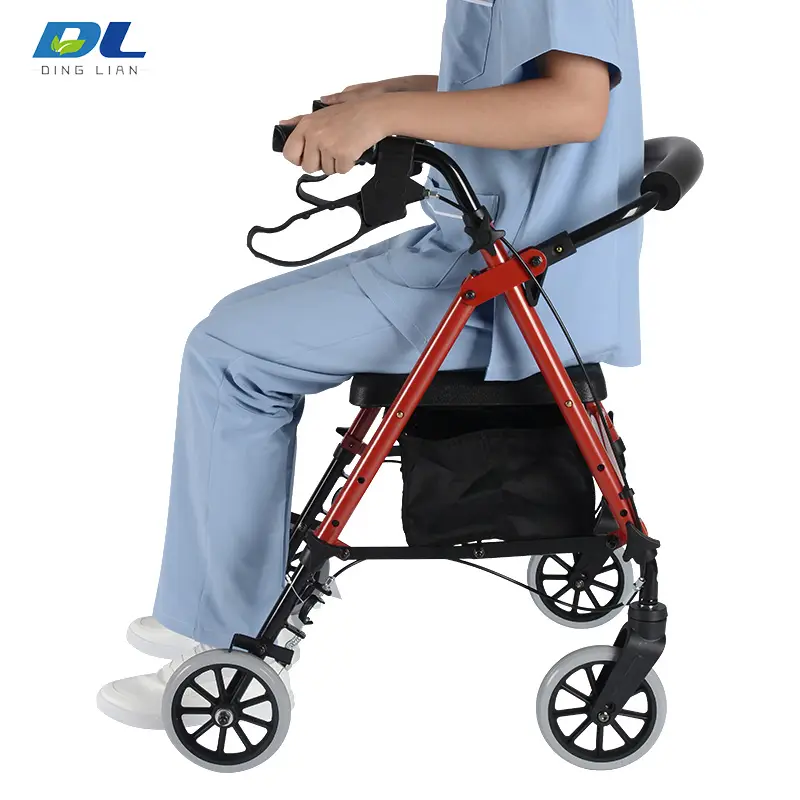
Yes. Tube wall thickness affects how a rollator frame resists bending, denting and repeated loading, but it should never be judged by itself. A thicker tube wall can increase material strength and fatigue resistance, yet a smaller tube with a thicker wall may still perform differently from a larger tube with a thinner wall. For buyers, the useful question is not simply “How many millimeters is the tube?” It is whether the tube diameter, wall thickness, alloy or steel grade, joint design, welding process and rated load have been engineered as one system.
Does a thicker tube wall automatically make a rollator stronger?
Not automatically. This is one of the most common shortcuts in rollator sourcing, and it can lead buyers to the wrong conclusion when comparing factories.
Tube wall thickness matters because increasing the amount of material around the tube generally increases resistance to local deformation and improves the section’s ability to carry bending loads. A thicker wall can also make the tube less vulnerable to dents caused by knocks, clamps, folding mechanisms or repeated handling.
But the outside diameter matters at the same time. A larger tube diameter can substantially improve resistance to bending because more of the material is positioned farther from the tube’s neutral axis. In practical manufacturing terms, changing from a small-diameter tube to a larger-diameter tube can sometimes produce a more useful structural improvement than simply adding material to the inside wall.
This is why a procurement team should avoid specifications such as “2.0 mm wall thickness required” unless the complete tube specification is defined. The supplier should be able to identify the tube outside diameter, wall thickness, material grade, temper or mechanical condition where relevant, and the location where that tube is used.
If two rollators have different tube dimensions, comparing wall thickness alone is not a fair structural comparison. The better question is whether each frame has enough structural margin for its intended load, repeated use and manufacturing configuration.
How does wall thickness affect load capacity and long-term durability?
Wall thickness has its strongest practical influence when the tube is exposed to repeated bending, localized force or impact. A rollator is not loaded only once. The frame experiences thousands of small loading events as the user leans on the handles, crosses thresholds, sits down, stands up, folds the frame and moves it over different surfaces.
For a manufacturer, this changes the design problem. A tube that survives one high static load may still be a poor choice if repeated loading gradually produces permanent deformation or fatigue damage around a joint.
1. Bending resistance
The frame tubes around the handles, front legs and seat-support structure can experience bending loads. A suitable wall thickness helps the tube retain its shape rather than developing excessive local deformation.
This is particularly relevant for rollators designed for higher user masses. However, the rated capacity should not be interpreted as a direct measurement of tube wall thickness. A manufacturer’s declared load rating represents the performance of the finished product, not simply the amount of metal in one tube.
2. Dent resistance
Thin-walled tubing can be more vulnerable to local dents. This matters because a dent is not always cosmetic. A sharp local deformation can change the stress distribution around the tube and create a weak area, especially when it occurs close to a bend, hole, clamp or welded connection.
For buyers inspecting samples, this is one reason to look beyond the polished finish. Check areas where tubes are cut, drilled, flattened, bent or connected. Those locations tell you more about the manufacturing discipline than the appearance of a straight tube section.
3. Fatigue resistance
Fatigue is more complicated than static strength. A frame can withstand a high load today but still experience damage after repeated loading over a long service period. Wall thickness can contribute to fatigue resistance, but weld geometry, heat-affected areas, tube bends and connection design can become equally important.
This is why serious rollator evaluation should look at the complete frame rather than treating wall thickness as the main durability indicator.
What matters more than wall thickness when comparing two rollator frames?
In actual sourcing work, I would normally compare at least five structural variables before deciding whether one frame is better than another. Wall thickness is one of them, not the whole decision.
| Factor | What to Check | Why It Matters | Typical Buyer Mistake | Better Purchasing Approach |
|---|---|---|---|---|
| Wall thickness | Actual tube wall and tolerance | Affects local strength, dent resistance and material mass | Assuming thicker always means stronger | Compare it together with tube diameter and material |
| Tube diameter | Outside diameter and cross-section | Strong influence on bending stiffness | Comparing only wall thickness | Evaluate the complete tube geometry |
| Material | Alloy or steel grade and condition | Determines mechanical properties and manufacturing behavior | Using “aluminum” or “steel” as the whole specification | Request the actual material specification |
| Welding | Joint design, penetration, consistency and heat control | Weak joints can limit the benefit of a strong tube | Judging welds by appearance only | Inspect critical joints and production consistency |
| Finished frame | Load, fatigue and functional performance | Confirms whether the complete design works as intended | Buying according to one material specification | Evaluate the finished product and test evidence |
The important point is the relationship between these factors. A tube with a thicker wall cannot compensate indefinitely for poor joint design. Likewise, a very strong alloy does not automatically make a poorly welded frame reliable.
Tube diameter and wall thickness should be specified together
If a buyer wants to establish a meaningful tube requirement, the specification should normally state both outside diameter and wall thickness. For example, “X mm outside diameter × Y mm wall thickness” is much more useful than “heavy-duty tubing.”
This also gives the factory something measurable to control during incoming material inspection and production. Vague terms such as “thick material” are difficult to verify and easy to interpret differently between suppliers.
Material grade changes the calculation
Aluminum and steel should not be compared simply by thickness. Their density, strength, stiffness, forming behavior and welding characteristics differ. Aluminum is attractive when a buyer wants lower product weight, while steel can provide a different balance of stiffness, cost and manufacturing robustness.
Even within aluminum or steel, different grades can have different mechanical properties. A factory that tells you only “6061 aluminum” or “carbon steel” without explaining the applicable material specification may not be giving you enough information for a serious technical comparison.
Why can two rollators with the same wall thickness have different durability?
Because the tube is only one component of the load path.
Consider a rollator handle. The user’s force enters through the handgrip, travels through the handle tube, reaches the frame connection, passes through the welded or mechanically joined section and finally transfers into the legs and wheels. If one connection is poorly designed, increasing the wall thickness of the straight tube may provide little benefit at the actual failure location.
The same principle applies to folding frames. A folding hinge introduces concentrated forces and moving interfaces. Holes, slots, pins and fasteners remove material or create local stress concentrations. The tube therefore needs to be evaluated together with the hardware surrounding it.
Welding is often where the real comparison begins
From a factory inspection perspective, I pay particular attention to joints rather than spending all the inspection time measuring straight tube sections.
A buyer should check whether critical joints are consistently positioned, whether weld profiles are repeatable, whether there are visible cracks or excessive undercut, and whether the welding process is appropriate for the material. For aluminum frames, heat input and joint preparation require particular attention because welding can influence the local properties of the material.
A robotic welding arm can improve repeatability of torch movement and positioning, but it does not automatically guarantee a good weld. Fixtures, welding parameters, material preparation, operator control and inspection still matter.
This is one reason production capability should be evaluated as a system. When reviewing a supplier’s factory equipment and manufacturing setup, the useful question is not how many machines are displayed. Ask how those machines are connected to the actual quality-control process.
How should buyers verify tube thickness before placing a bulk rollator order?
This is where procurement discipline makes a real difference. You do not need to turn every sourcing project into a laboratory exercise, but you do need enough information to prevent a specification from changing after the sample approval.
Step 1: Define the complete tube specification
Ask the supplier to document the tube outside diameter, wall thickness, material grade and applicable tolerance. If several tubes are used in the same frame, identify which specification applies to the main frame, handle tube, front legs and supporting members.
Step 2: Check the sample against the approved drawing
A sample is not only for appearance approval. It should establish the construction standard that later production will follow. If the sample uses one tube specification and mass production uses another, the commercial approval has little technical value.
Step 3: Verify dimensions with appropriate measuring equipment
For an accessible tube end, wall thickness can be checked directly. For finished assemblies, ultrasonic thickness measurement or destructive verification may be used depending on the buyer’s inspection system and the material involved.
The goal is not to measure every tube on every unit. The goal is to establish a practical sampling method and acceptance tolerance before production starts.
Step 4: Inspect critical welded areas
Look at the joints that transfer the user’s load into the frame. Check consistency across multiple samples, not just one attractive production piece.
Step 5: Review the finished product’s performance evidence
ISO 11199-2:2021 provides requirements and test methods for rollators, including safety, ergonomics and performance based on everyday use and the maximum user mass specified by the manufacturer. The standard is therefore more useful to a buyer than a tube-thickness number taken out of context. :chatgpt-content-reference{index=”0″}
A supplier should be able to explain how the declared load rating relates to the finished frame and applicable testing. If the conversation stops at “our tube is 1.5 mm,” you have not yet established whether the complete product is suitable for your market.
What tube specification should a distributor ask a rollator manufacturer for?
For distributors and importers, the best specification is one that can be checked during production. Avoid creating a specification sheet full of numbers that the factory cannot consistently verify.
| Procurement Item | What to Request | How to Verify | Why It Matters | Recommended Decision |
|---|---|---|---|---|
| Tube size | Outside diameter and wall thickness | Sample measurement | Defines basic frame geometry | Record in approved specification |
| Material | Grade and applicable standard | Mill certificate or supplier documentation where required | Affects strength and processing | Do not accept generic material descriptions |
| Welded joints | Critical joint locations and welding requirements | Visual and dimensional inspection | Transfers load between frame members | Define critical inspection points |
| Load rating | Declared maximum user mass | Technical documentation and applicable testing | Connects design with market positioning | Match rating to target market |
| Production consistency | Sampling and tolerance requirements | Pre-shipment inspection | Prevents sample-to-production variation | Agree acceptance criteria before PO |
The most useful factory specification is not necessarily the one with the most numbers. It is the one that the factory can control, the buyer can verify, and both sides can refer to when a production dispute occurs.
Is a lightweight rollator always less durable than a heavier one?
No. Weight and durability are related, but they are not interchangeable.
A heavier frame may contain more material, but that does not prove better structural design. Conversely, a lightweight aluminum rollator can achieve a useful balance of strength and portability when the tube geometry, material selection, joints and load path have been engineered correctly.
This distinction matters commercially. Many distributors sell through channels where caregivers or end users frequently load the rollator into vehicles. An unnecessarily heavy product can create a practical disadvantage even if its frame is structurally robust.
The better purchasing objective is therefore not “maximum wall thickness.” It is the lowest practical product weight that still provides the required structural performance, durability and safety margin for the intended market.
Why this matters for product positioning
A distributor supplying hospitals or care institutions may prioritize durability, repeatability and documentation. A retailer serving private households may place more emphasis on portability and folding convenience. The same tube specification should not automatically be used for every product category.
This is also where product range planning becomes useful. Instead of forcing one frame construction to cover every customer segment, a manufacturer can develop different combinations of material, tube geometry, accessories and frame configuration around different use requirements.
What should buyers ask a manufacturer before approving a rollator frame?
If I were evaluating a new rollator supplier, I would keep the technical conversation fairly simple. The following questions usually reveal much more than asking whether the factory can produce a “heavy-duty” model.
- What are the outside diameter and wall thickness of each main frame tube?
- What material grade is being used, and is the specification documented?
- Which frame joints carry the highest loads?
- How are tube dimensions controlled during incoming inspection?
- How is welding consistency controlled during mass production?
- What is the declared maximum user mass of the finished rollator?
- What testing or inspection evidence supports the rated capacity?
- How are changes to tube material or dimensions controlled after sample approval?
That last question is often overlooked. A buyer may approve a sample based on excellent construction, then discover months later that the supplier has changed tubing to reduce cost. A controlled specification and change-approval process is therefore just as important as the original design.
For buyers reviewing an established product range, the rollator walker range should be evaluated by complete product configuration rather than by a single tube measurement. Frame dimensions, weight, user capacity, seat configuration, wheels and folding structure all affect the commercial suitability of a model.
What is the best way to compare rollator durability between factories?
Compare like with like. This sounds obvious, but many purchasing comparisons fail because the suppliers are quoting different construction standards under similar product names.
Start with the same intended user mass, similar frame dimensions and similar functional configuration. Then compare tube geometry, material, welding, hardware and testing. If one supplier quotes a thicker tube but uses a smaller diameter, while another uses a larger diameter with a thinner wall, the two numbers cannot be judged independently.
Next, look at manufacturing consistency. A technically excellent design is not commercially useful if production variation is high. For a distributor, repeated quality is usually more valuable than one unusually strong sample.
This is where an experienced factory partner becomes easier to evaluate. Zhongshan Dinglian Rehabilitation Equipment Co., Ltd. approaches rollator production as a complete manufacturing process rather than treating the tube as an isolated purchasing item. The relevant questions include material preparation, tube forming, welding, assembly, inspection and final product consistency.
Buyers who want to understand the company’s manufacturing background can review the company and factory information before discussing a specific project.
Frequently Asked Questions
Does a thicker tube wall increase rollator load capacity?
It can contribute to higher structural strength, but wall thickness alone does not determine the finished product’s load capacity. Tube diameter, material, joint design, welding and the complete frame structure must also be considered.
Is 1.5 mm tubing better than 1.2 mm tubing for every rollator?
Not necessarily. The outside diameter and material grade can change the structural performance significantly. A 1.5 mm wall should not be treated as universally superior without comparing the complete tube specification and frame design.
Should distributors specify tube wall thickness in a purchase order?
Yes, when the tube construction is important to the approved design. It is better to specify outside diameter, wall thickness, material and applicable tolerance together than to use vague terms such as heavy-duty tubing.
Does a heavier rollator always last longer?
No. Extra weight may come from additional material, but it does not automatically prove better structural performance. A properly engineered lightweight aluminum frame can provide a useful balance between durability and portability.
What should I request from a rollator factory before placing a bulk order?
Request the approved tube specifications, material information, declared user mass, relevant test evidence, sample approval records and production inspection criteria. For a larger project, agree how dimensional and material changes will be handled before mass production.
Tube wall thickness is worth checking because it affects the structural behavior of a rollator. But from a buyer’s perspective, it should be treated as one part of a larger engineering decision. The reliable frame is not the one with the thickest tube on paper. It is the one where material, tube geometry, welding, joints, testing and production control all work together and remain consistent from the approved sample to the bulk shipment.
For procurement teams comparing suppliers, the next useful step is usually to review the manufacturer’s actual production capability and discuss the intended load rating, material choice and target quantity together. If you have a specific rollator project, you can contact Zhongshan Dinglian Rehabilitation Equipment Co., Ltd. with your target market, required user capacity and preferred frame construction for a more practical technical discussion.
Buyer Takeaway: Do Not Buy the Millimeter—Buy the Structural System
When a supplier tells you that its rollator uses a thicker tube, that is useful information, but it is not the final purchasing answer. The stronger procurement approach is to ask what that wall thickness is doing within the complete frame.
A suitable rollator design balances tube diameter, wall thickness, material properties, welding, joints, hardware, weight and the required user mass. Increasing wall thickness may improve resistance to deformation, but it also adds material and weight. Reducing thickness may save weight and cost, but only works when the rest of the structure is designed and controlled accordingly.
For distributors and institutional buyers, this distinction matters because durability is ultimately a product-level result. The tube specification should support the design, while testing and production control provide the evidence that the finished rollator performs consistently.
That is the standard worth using when comparing manufacturers: not “Which supplier has the thickest tube?” but “Which supplier can explain, control and reproduce the complete frame construction behind the claimed load capacity?”